


With the revenue of the global hotel market projected to reach hundreds of billions this year, understanding how much of that revenue actually stays in your bank account is critical. Top-line revenue frequently masks severe underlying vulnerabilities in a property’s financial health. Discover how to accurately calculate your hotel profit margin, identify hidden operational leaks, and implement proven strategies to drive unprecedented bottom-line growth.
What Is Hotel Profit Margin?
Hotel profit margin is defined by the exact percentage of a hotel’s revenue remaining after subtracting absolutely all business expenses. This includes massive overhead costs such as staff wages, property maintenance, utility consumption, and digital marketing expenditures. It serves as the ultimate, unfiltered reflection of a hotel’s true financial health. The higher the margin percentage, the more efficient and profitable the physical property.

Margins at hotels and other accommodation properties can be strategically manipulated in a number of ways. Owners can drastically reduce variable expenses, increase room revenue through dynamic pricing, or boost ancillary spending in specific departments. Understanding how these distinct operational levers interact is the first fundamental step toward achieving better overall finances.
A high occupancy rate does not inherently guarantee a high profit margin. If a hotel aggressively slashes its Average Daily Rate (ADR) to sell out the building, the resulting operational costs (housekeeping, linens, electricity) may entirely consume the discounted revenue. Tracking profit margins ensures that every commercial decision is evaluated strictly through the lens of actual net profitability rather than sheer booking volume.
Why Are Hotel Profit Margins Important To Measure?
Tracking your margin provides a clear, unvarnished indication of the overall financial health of your business. You must know exactly if you are gaining or losing money on a daily, weekly, and monthly basis to prevent catastrophic cash flow shortages.

Understanding your profit margins allows you to:
- Benchmark Performance: Compare your hotel directly with industry standards and available competitor data to assess where you stand in your local market.
- Make Strategic Decisions: Determine exactly where to invest your capital to further improve the property or which underperforming departments require immediate budget cuts.
- Protect Asset Valuation: A healthy, expanding profit margin significantly increases the underlying real estate value if you ever intend to sell the business.
- Build Economic Resilience: Strong margins provide a critical financial buffer against unexpected macroeconomic events, supply chain disruptions, or sudden travel demand drops.
How Are Hotel Profit Margins Calculated?
Hotel profit margins are calculated by determining the exact percentage of a hotel’s revenue that remains after stripping away all operational and fixed costs. This complex mathematical process is typically evaluated in two highly specific stages to provide maximum operational clarity.
Stage 1: Gross Operating Profit (GOP) Margin
This metric specifically reflects the efficiency of core, day-to-day hotel operations. It is calculated by subtracting the cost of goods sold (expenses directly tied to room sales and daily operations) from total room revenue. It clearly highlights how well the management team is balancing labor and supply costs against the daily room rate.
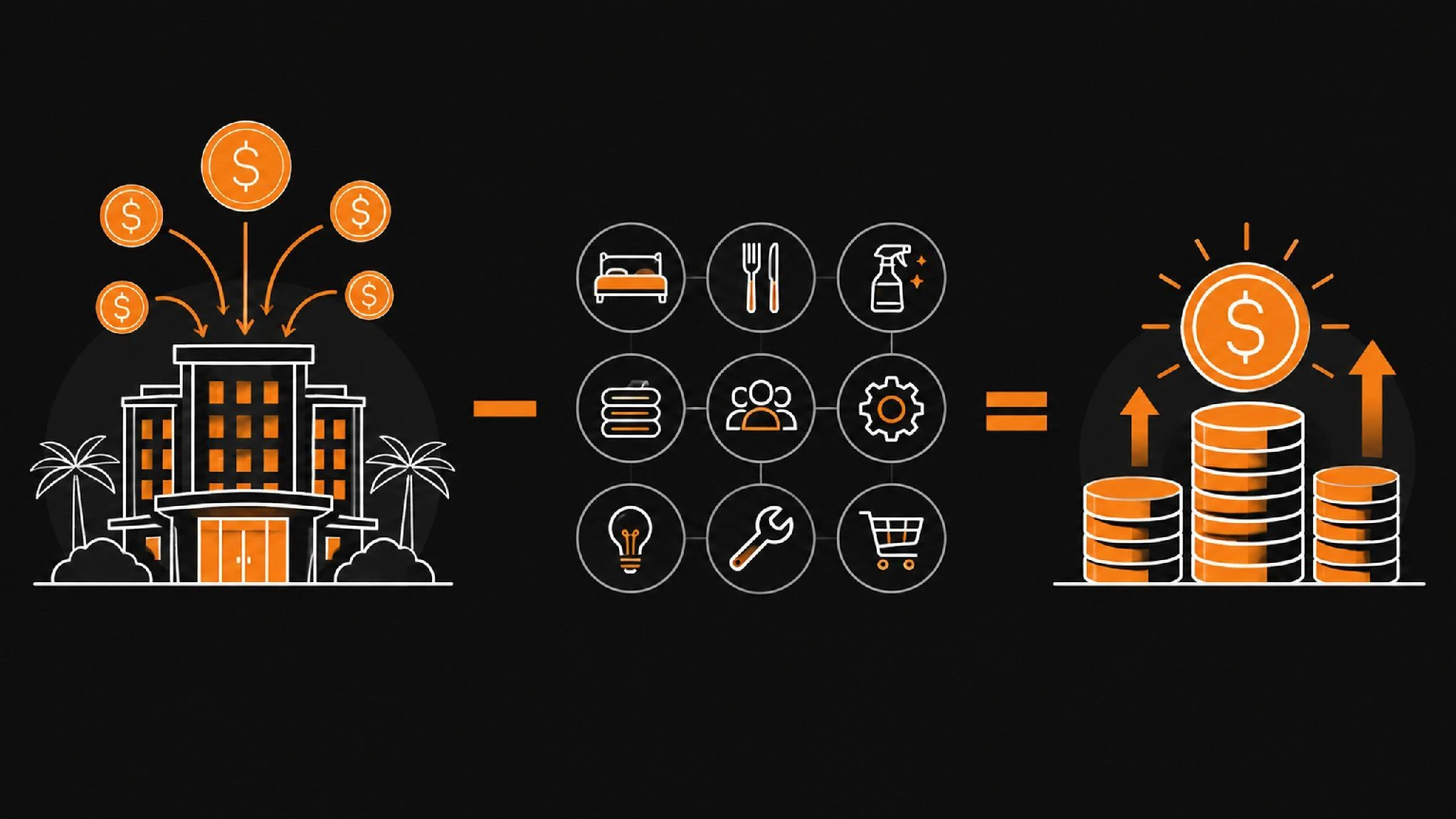
Formula: (Gross Operating Profit / Total Room Revenue) * 100 = GOP Margin %
Stage 2: Net Profit Margin
This represents the ultimate profitability metric for the asset owner. It takes the Gross Operating Profit and subtracts absolutely all other remaining expenses, including non-operational costs like franchise fees, property taxes, mortgage interest, and capital reserve contributions.

Formula: (Net Profit / Total Property Revenue) * 100 = Net Profit Margin %
A Practical Calculation Example
Let us examine a hypothetical monthly financial scenario using standard sample numbers:
- Total Property Revenue: $120,000
- Cost of Goods Sold (COGS): $10,000
- Operating Expenses (Labor, Utilities, etc.): $55,000
First, calculate the Gross Operating Profit (GOP):
- $120,000 (Revenue) –
- 10,000(COGS)=∗∗
- 10,000(COGS)=∗∗
- 110,000 GOP**
Next, calculate the Net Profit:
- $110,000 (GOP) –
- 55,000(OperatingExpenses)=∗∗
- 55,000(OperatingExpenses)=∗∗
- 55,000 Net Profit**
Finally, determine the Net Profit Margin Percentage:
- ($55,000 Net Profit / $120,000 Total Revenue) * 100 = 45.8% Net Profit Margin
Are Hotels Profitable In The Modern Market?
Is owning a hotel actually profitable? The answer is relative and depends entirely on a complex range of variables. Some hotels are incredibly profitable, generating massive cash flow, while others constantly struggle and do not survive long term.
Just like any business-to-consumer enterprise, the profitability of a hotel relies heavily on:
- Maintaining a solid, highly adaptable business plan.
- Implementing effective, data-driven revenue management strategies.
- Ensuring exceptional customer satisfaction to build a positive digital reputation.
Hotels are generally burdened by massive fixed costs. Mortgage payments, property taxes, and baseline insurance premiums must be paid regardless of whether the hotel is sitting at 100% or 10% occupancy. This fixed-cost reality can cause baseline profit margins to be significantly lower than in many other retail industries. The short answer is yes, hotels are highly profitable, but only when they are managed successfully and efficiently.
What Is A Good Net Profit Margin For A Hotel?
If we are determining a good baseline hotel net profit margin to aim for, most properties would be satisfied operating with a consistent margin of 15% to 20%.

Very healthy, highly optimized margins typically lie between 25% and 35%, while the global industry average might be closer to the 5% to 10% range. Generally, premium luxury resorts and massive corporate brands can drive a much higher margin due to pricing power and economies of scale. Smaller boutique properties and independent brands typically expect slightly lower margins due to limited ancillary revenue opportunities and higher proportional distribution costs.
What Factors Drive Profit At A Hotel?
Hotels drive revenue and profit through two distinct avenues: primary and secondary sources. Understanding how these sources interact is critical for margin expansion.

The primary source of income for any lodging facility is room sales. Generally, a guest’s biggest single expense when staying at a hotel is paying the base rate for the room itself. Optimizing the Average Daily Rate is the fastest way to increase the primary profit margin because room rate increases flow almost entirely to the bottom line.
Secondary sources of income, often referred to as ancillary revenue, represent a massive opportunity for margin growth. These include:
- Food and beverage sales (restaurants, bars, room service).
- Premium amenity fees (valet parking, pet fees, early check-in).
- Health and wellness services (spa treatments, private fitness classes).
- Event and meeting space rentals.

True profitability comes from being able to sell these ancillary services at a high premium while strictly keeping the associated labor and inventory costs exceptionally low.
10 Proven Strategies To Improve Hotel Profitability
The very first step you must take in your journey toward profitability is performing a comprehensive hotel profitability analysis. This means taking a deep, unvarnished look into the current state of your business to identify current revenue, costs, and departmental margins. If you are looking for a highly actionable plan, here are ten proven ways to boost profit at your property.
1. Reduce Overhead And Operating Costs
A primary reason why hotels face low profit margins is the massive, compounding cost of daily operations. Balancing cost-efficiency with service quality is paramount. Start by making energy efficiency an absolute priority. Installing energy-efficient appliances, smart thermostats, and motion sensors in guest rooms and public areas can dramatically reduce utility bills without compromising guest comfort.

Managing physical inventory and controlling supplies with precision are additional ways to improve margins. Ensure careful, aggressive negotiation with all vendors to secure the absolute best wholesale rates possible for linens, cleaning chemicals, and food supplies.
2. Forecast Staffing Needs Accurately
Labor typically makes up approximately half of a hotel’s total operating costs, making accurate staffing forecasts essential for survival. This ensures you are neither overstaffed nor understaffed, both of which severely impact profits and the guest experience.

Cross-train your staff so that during low-occupancy periods, they can seamlessly fill roles across different departments, ensuring all areas remain adequately covered. By accurately predicting demand and scheduling staff dynamically, you can optimize your labor model to meet service needs efficiently and avoid unnecessary, expensive overtime pay.
3. Practice Advanced Revenue Management
One of the key ways to maximize profit is to deeply understand and optimize room revenue. With a dedicated revenue management tool, you can automatically adjust room rates according to real-time market demand.

A successful revenue management strategy involves setting the exact right rate, for the right room, at the exact right time. This allows you to reach your ideal guests without ever leaving money on the table. When perfectly aligned with demand, dynamic pricing enhances profit margins by improving occupancy at the highest possible rate.
4. Implement Competitive Pricing Strategies
Pricing is the ultimate lever for your hotel’s profit margin. If you price rooms too low, you risk creating a thin margin that fails to cover baseline operating expenses. Sometimes it is financially better to leave a room completely unoccupied than to charge a deeply discounted rate that does not even cover the variable cost of cleaning it.

To maintain strict competitiveness, constantly compare your hotel’s prices to similar local properties and adjust rates rapidly based on demand. A competitor-based pricing strategy helps you set rates that perfectly reflect current macroeconomic market conditions.
5. Find Creative Ways To Boost RevPAR
With room rates constantly fluctuating, optimizing Revenue Per Available Room (RevPAR) becomes essential to maximizing your revenue potential. By increasing either the occupancy rate or the room rate, you can achieve a higher RevPAR without significantly raising your fixed costs.
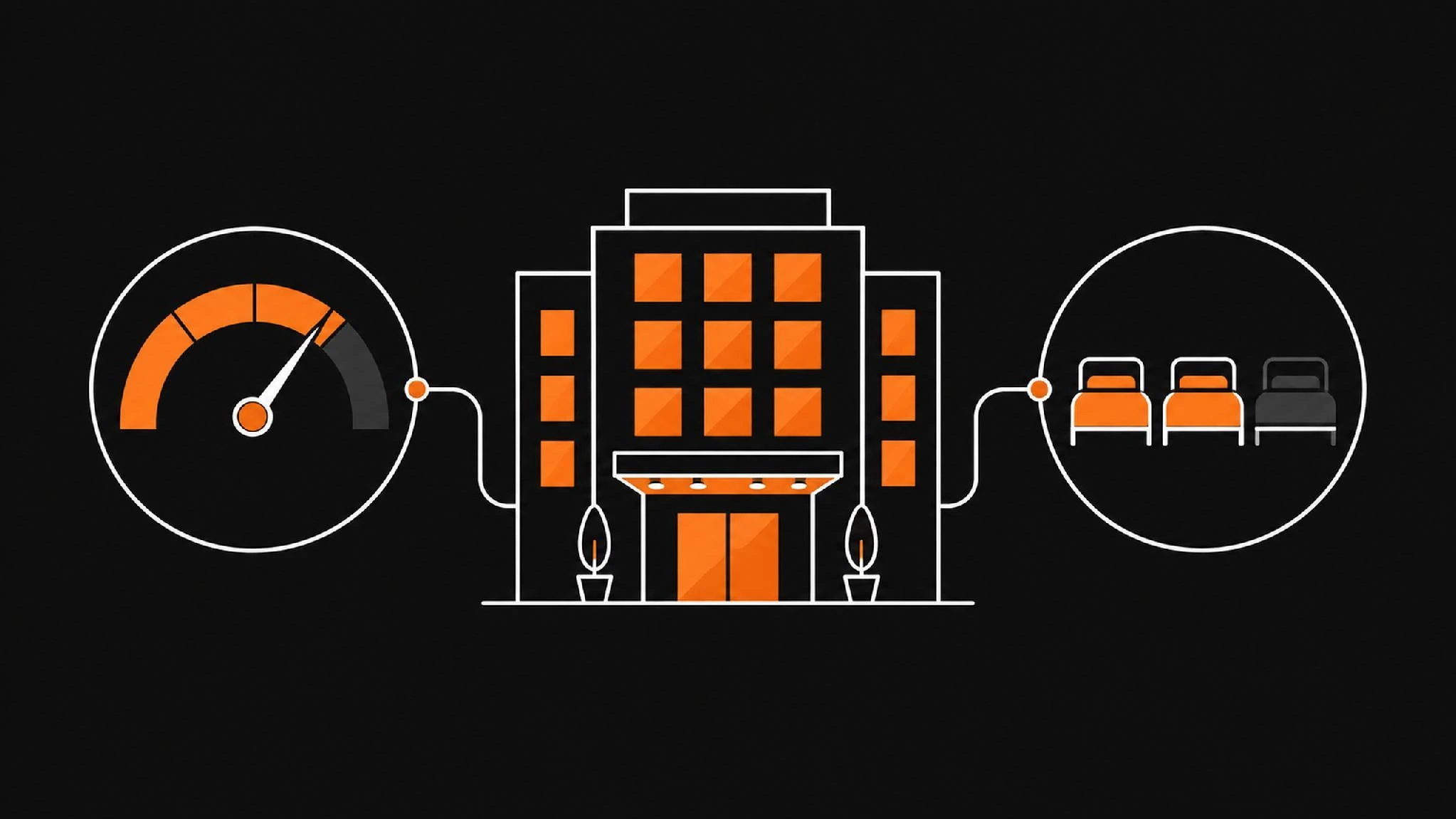
The more you are able to spread your massive fixed costs across a higher volume of occupied rooms, the higher the net revenue per room. This mathematical efficiency ultimately leads to significantly better gross profit margins at the end of the month.
6. Leverage Automation And Hotel Technology
Automation is an absolute game-changer for protecting profit margins. With a cloud-based Property Management System (PMS), you can seamlessly streamline a wide range of operational tasks that would typically demand substantial administrative overhead and high labor costs.

For a single predictable monthly fee, a modern PMS can handle digital check-ins, automated reservations, smart room assignments, and seamless guest billing. This technological setup allows your core team to operate incredibly efficiently without requiring a large administrative staff, cutting costs while still delivering a flawless guest experience.
7. Diversify Your Revenue Streams
Relying exclusively on transient room bookings can be incredibly risky, especially during notoriously low seasons when travel revenue dips. To keep income highly steady year-round, it is essential to aggressively diversify your revenue streams.

Consider heavily promoting your venue for weddings, corporate retreats, or graduation parties during quieter winter months. Creating special experiential packages attracts entirely different audiences. Building strong connections with the local community can also help position your hotel restaurant or bar as a high-revenue hub for locals.
8. Reduce Employee Turnover
Reducing employee turnover is absolutely essential to managing costs and maintaining high service quality. Implementing programs that offer highly competitive benefits, clear career growth opportunities, and ongoing professional training fosters deep employee engagement.

Retention programs save massive amounts of money and time that would otherwise be wasted on constantly training new hires. When your team is highly committed and well-trained, their efficiency improves, which has a direct, positive impact on guest satisfaction and long-term profitability.
9. Optimize Your Marketing Spend
Marketing can easily become one of the biggest expenses for a hotel after payroll. Finding strategic ways to optimize your digital marketing spend is essential. Focus exclusively on investing in campaigns targeted at your most highly profitable guest segments to guarantee the highest return on investment.

Strengthening your proprietary booking channels through targeted Local SEO, loyalty programs, and direct booking incentives drastically reduces your dependency on Online Travel Agencies (OTAs). Bypassing OTA commissions helps you instantly cut acquisition costs while attracting highly profitable direct guests.
10. Control Inventory And Supply Waste
Physical inventory and daily supplies can quickly become a massive operational expense if left unchecked. Using your PMS to track physical inventory closely helps you significantly reduce waste and only reorder exactly when necessary.
Sustainable choices, such as installing refillable soap and shampoo dispensers instead of single-use plastic bottles, offer massive cost savings over time. Auditing your food and beverage waste weekly ensures that your kitchen is not silently destroying your restaurant’s profit margin.
What Tools Can Help Increase Hotel Profit Margins?
Improving profit margins requires significantly more than just randomly cutting costs; it depends heavily on using the exact right tools to optimize pricing. Here are three core digital systems that directly support hotel profitability.
Revenue Management Systems (RMS)
RMS tools automatically optimize room pricing based on real-time market demand and competitor data. They help hotels sell the right room at the absolute best price while simultaneously uncovering hidden opportunities in group bookings and ancillary revenue forecasting.
Property Management Systems (PMS)

A modern, cloud-based PMS automates massive operational workflows such as online reservations, mobile check-in, and complex billing. This technology drastically reduces human administrative errors and frees up your front desk staff to focus entirely on higher-value, revenue-generating guest interactions.
Automated Digital Marketing Platforms

These sophisticated tools help independent hotels target the exact right guests with highly personalized campaigns through channels like email and retargeting ads. Advanced marketing platforms increase direct bookings and total guest spend with significantly lower acquisition costs than traditional advertising.
Conclusion
Hotel profit margin is the ultimate indicator of your property’s financial health. Relying solely on top-line revenue or high occupancy rates provides a dangerous illusion of success. By accurately calculating your Gross Operating Profit, aggressively reducing operational overhead, implementing dynamic pricing, and minimizing OTA commission fees, you can transform your property into a highly efficient, highly profitable asset.
Ready to maximize your direct revenue and improve your operational margins? Shifting from a high-commission, volume-based model to a strategy focused entirely on direct profitability requires flawless digital infrastructure.
Partner with the hospitality digital marketing professionals at ROI300 to optimize your direct booking channels, dominate local search, and bypass expensive OTA fees. Contact ROI300 today to elevate your commercial strategy and unlock the absolute full financial potential of your hotel.