

Marketing professionals, hotel general managers, and hoteliers looking to elevate their hospitality marketing can learn a great deal from Marriott International’s multifaceted marketing strategy. As one of the world’s largest hotel companies with 30+ brands and nearly 9,500 properties worldwide, Marriott has pioneered innovative approaches to digital marketing, loyalty, branding, partnerships, and more. In this in-depth analysis, we explore Marriott’s digital marketing tactics, the powerhouse Marriott Bonvoy loyalty program, global branding and positioning, high-impact partnerships and sponsorships, content marketing and social media initiatives, case studies of major campaigns, data-driven marketing efforts, and how Marriott’s approach has evolved through 2024. We’ll also compare Marriott’s strategy with key competitors like Hilton, Hyatt, and IHG to identify what sets Marriott apart.
Whether you’re a hotel marketing executive or a hospitality professional, read on for actionable insights into how Marriott marketing strategy drives customer engagement, brand loyalty, and global growth through smart marketing.

Marriott’s Digital Marketing Tactics
Marriott’s marketing strategy is deeply rooted in digital innovation and omnichannel engagement. The company has invested heavily in its online presence – from a robust website and mobile app ecosystem to aggressive search marketing and social media campaigns. Marriott recognizes that today’s travelers begin their journey online, and it aims to capture demand at every digital touchpoint. Key digital tactics include:
Search Engine Optimization (SEO) and Paid Search
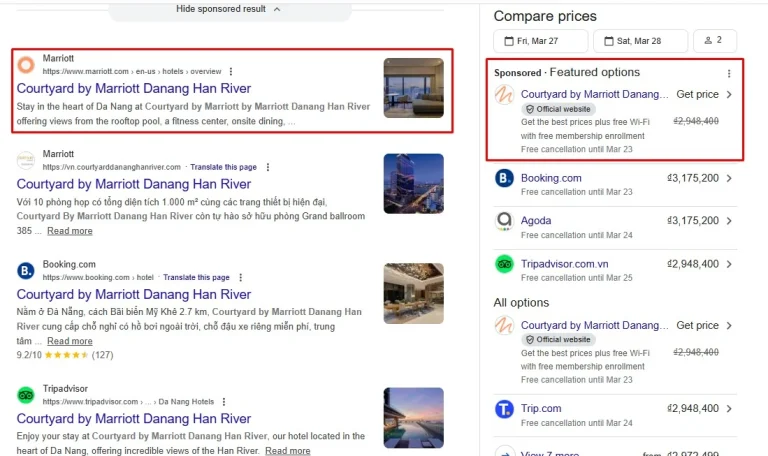
Marriott ensures its hotels and brands rank highly for travel searches. By optimizing local hotel pages and bidding on travel keywords, Marriott drives direct traffic to Marriott.com, reducing reliance on third-party OTAs. A strong direct booking focus has paid off: by 2022, direct bookings through Marriott’s digital channels saw a 27% increase in room nights and 41% higher revenue compared to prior years – a clear sign that Marriott’s digital strategy is capturing more customers directly.
Marriott Bonvoy Mobile App
The Marriott Bonvoy app is central to digital engagement. Marriott has continuously enhanced the app with features like mobile check-in/check-out, mobile room keys, in-app service requests, and personalized offers. This not only streamlines the guest experience but also provides a rich marketing channel. The app sends targeted push notifications and promotions based on user behavior and preferences.
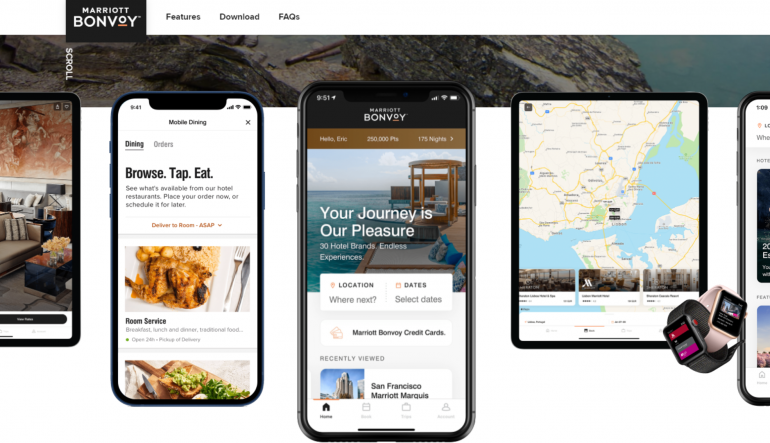
For example, the app might suggest an upgrade or dining offer during a stay, or promote a special rate for an upcoming weekend – all carefully personalized through data analytics. By 2018, Marriott found that giving guests a seamless, hassle-free app experience (inspired by user expectations set by theme parks and airlines) resulted in higher engagement and loyalty. Marriott’s challenge was to market the app’s benefits without being intrusive – which it achieved via geo-targeted suggestions and a balance of utility vs. promotion.
Email and CRM Marketing
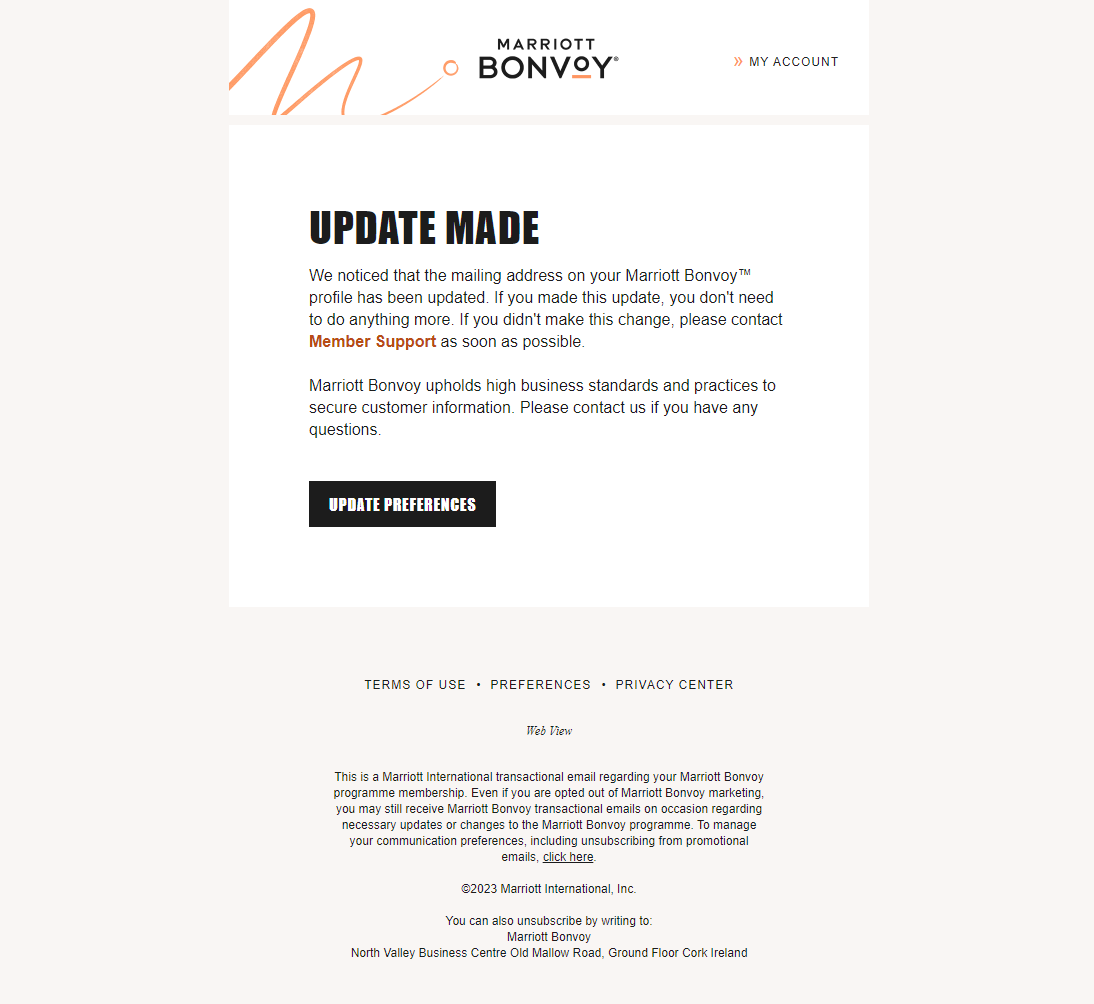
With millions of customers in its database, Marriott employs sophisticated customer relationship management (CRM) tools to send segmented email campaigns. These emails include personalized offers such as destination deals aligned with past travel history, or loyalty account updates that prompt the next trip. Marriott’s use of data analytics enables tailoring content to specific guest segments, which has increased conversion rates and engagement. For instance, a family traveler might receive a promotion for a resort vacation, while a business traveler gets offers for city hotels during weekdays. This data-driven personalization makes Marriott’s digital marketing feel more like a helpful concierge than generic advertising.
Social Media Advertising
Marriott allocates significant spend to social media ads on platforms like Facebook/Instagram, YouTube, and more recently TikTok. These ads often use rich visuals of destinations and properties to inspire travel dreams.

Notably, Marriott’s campaigns on Instagram leverage the platform’s visual nature to showcase exotic resorts, sleek urban hotels, and unique experiences. Marriott also utilizes social retargeting ads – for example, if a user searches for hotels in Hawaii on Marriott.com but doesn’t book, they might later see a Facebook ad for a Marriott hotel in Maui. This omnichannel retargeting helps recapture potential guests with relevant messaging.
Meta-Search and Online Travel Agency (OTA) Strategy
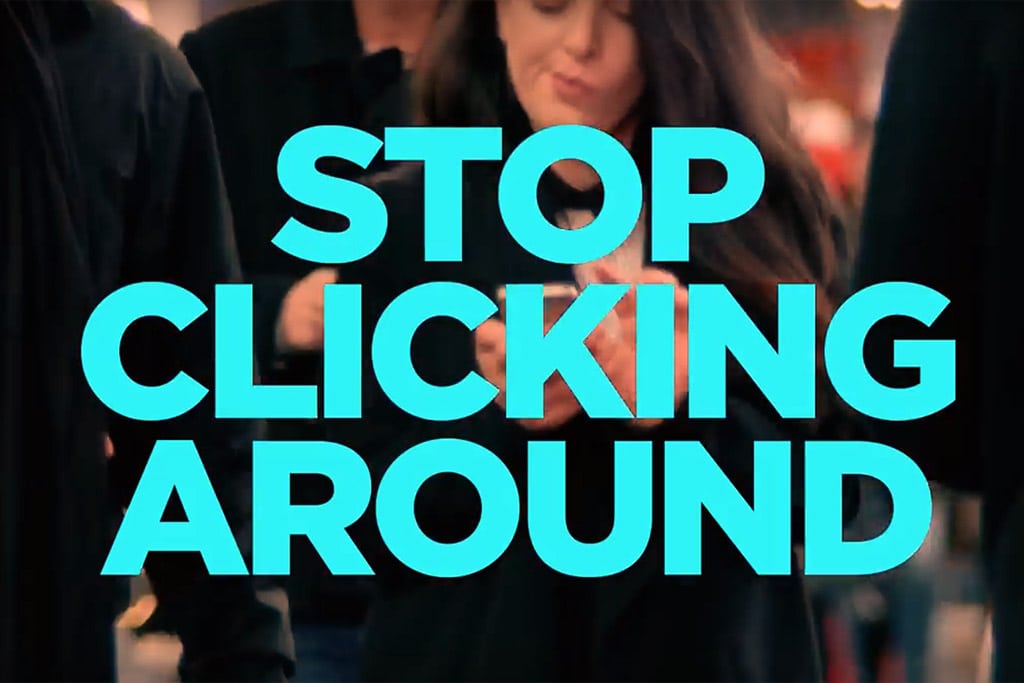
While encouraging direct bookings, Marriott still maintains a presence on travel search aggregators (Google Hotel Ads, TripAdvisor, etc.) and selectively on OTAs. However, Marriott often provides member-exclusive rates on its own channels to incentivize booking direct. This strategy emerged industry-wide around 2016; Marriott followed competitors in launching loyalty member rates and slogans akin to Hilton’s “Stop Clicking Around” to underline that the best deals are on Marriott’s platforms. By offering a 2-5% discount to Bonvoy members booking direct, Marriott both grows its loyalty base and undercuts the appeal of OTAs on price. The result is cost savings on commissions and a direct relationship with the customer for future marketing.
Digital Content and User Experience
Marriott constantly iterates on its website and app UX to improve conversions. For example, the Marriott.com homepage and booking flow are optimized for speed and simplicity, knowing that even a few seconds of delay can cause drop-off. They also incorporate trust signals like Marriott Bonvoy branding and personalization (e.g. “Welcome back, [Name], use your points on your next stay in New York!”) when logged in. Furthermore, Marriott’s Marriott Digital Services (MDS) team functions as an in-house digital agency to help individual hotel properties with SEO, social media, and paid campaigns. This ensures consistency and expertise in digital marketing across thousands of hotels, whether managed or franchised.
Marriott’s digital marketing prowess is robust and constantly evolving. By integrating content marketing, SEO/SEM, email, and mobile technologies, Marriott meets customers wherever they are in the digital journey. The strategy is paying dividends in driving direct bookings and engagement – critical in a world where customer acquisition costs and competition from OTAs are ever increasing.
Marriott Bonvoy: Loyalty Program as a Marketing Powerhouse
One of Marriott’s most powerful marketing weapons is its loyalty program, Marriott Bonvoy. Launched in 2019, Bonvoy unified the former Marriott Rewards, Ritz-Carlton Rewards, and Starwood Preferred Guest (SPG) programs into a single platform. This consolidation was a strategic move that created one of the world’s largest loyalty programs, dramatically expanding the pool of members that Marriott’s marketing can reach and engage. Bonvoy has become the connective tissue across Marriott’s 30+ brands, and it’s central to Marriott’s strategy of driving repeat business and direct customer relationships.
Scale and Membership Growth
The scale of Marriott Bonvoy is staggering – as of the end of 2022 it had 177 million members, a 36% increase since its launch. By mid-2025, Marriott reported the program had grown to over 230 million members worldwide, underscoring its continued momentum. This immense membership base not only represents a large marketing audience, but also a treasure trove of first-party data (profiles, stay histories, preferences) that Marriott leverages for targeted marketing.

For comparison, Hilton Honors has about 210 million members and IHG One Rewards around 115 million, making Marriott Bonvoy the largest hotel loyalty program by membership. The sheer size gives Marriott a competitive edge – a massive captive audience for promotions, brand campaigns, and upselling of Marriott’s portfolio.
Driving Direct Bookings and Revenue
Marriott Bonvoy is fundamentally a marketing vehicle to drive direct bookings and increase guest lifetime value. Bonvoy members are incentivized to book through Marriott channels (website, app, call centers) by earning points – which not only fosters loyalty but also saves Marriott the OTA commissions. The strategy has shown concrete results: a key driver of Marriott’s post-pandemic recovery was the surge in loyalty member bookings.
In 2022, over half of room nights were booked by Bonvoy members, and Marriott’s CFO noted that loyalty guests spend more per stay and stay more frequently than non-members. Marriott’s 2023 campaign tagline “Where Can We Take You?” explicitly pitched the Bonvoy app as the portal to book all 8,000+ Marriott hotels. By making Bonvoy synonymous with endless choice and personalized rewards, Marriott is effectively marketing its app as a one-stop shop for travel, challenging customers to ditch multi-brand OTA apps in favor of Marriott’s ecosystem.
Benefits and Emotional Connection
While points and perks are the tangible rewards, Marriott emphasizes that Bonvoy is about more than just free nights – it’s about recognition and emotional connection. Elite members enjoy benefits like room upgrades, late checkout, free breakfast/lounge access, which Marriott heavily markets as enhancing the guest experience (e.g. “Unlock Silver status and enjoy late checkout on your next trip!”).
Marriott deliberately crafts marketing messages that make members feel valued and part of an exclusive travel club. Personalized service – such as greeting elites by name or tailoring on-property experiences – is often highlighted in Bonvoy marketing to reinforce an emotional bond. Marriott’s own analysis notes that Bonvoy’s success “is not merely based on the points system; its value lies in the emotional connection it creates with guests”. By treating loyalty as a relationship rather than a transaction, Marriott fosters what its marketers call “love-based loyalty,” where customers feel genuinely understood and appreciated.
Global Branding and Positioning Strategies
With dozens of distinct hotel brands under its umbrella – from luxury icons like The Ritz-Carlton and St. Regis to mid-scale staples like Courtyard and Fairfield Inn – Marriott International is a master of brand portfolio management. Its marketing strategy carefully positions each brand while also promoting the overarching Marriott Bonvoy master brand. This dual branding approach allows Marriott to target diverse customer segments and travel occasions without diluting what “Marriott” stands for globally.
Diversified Brand Portfolio
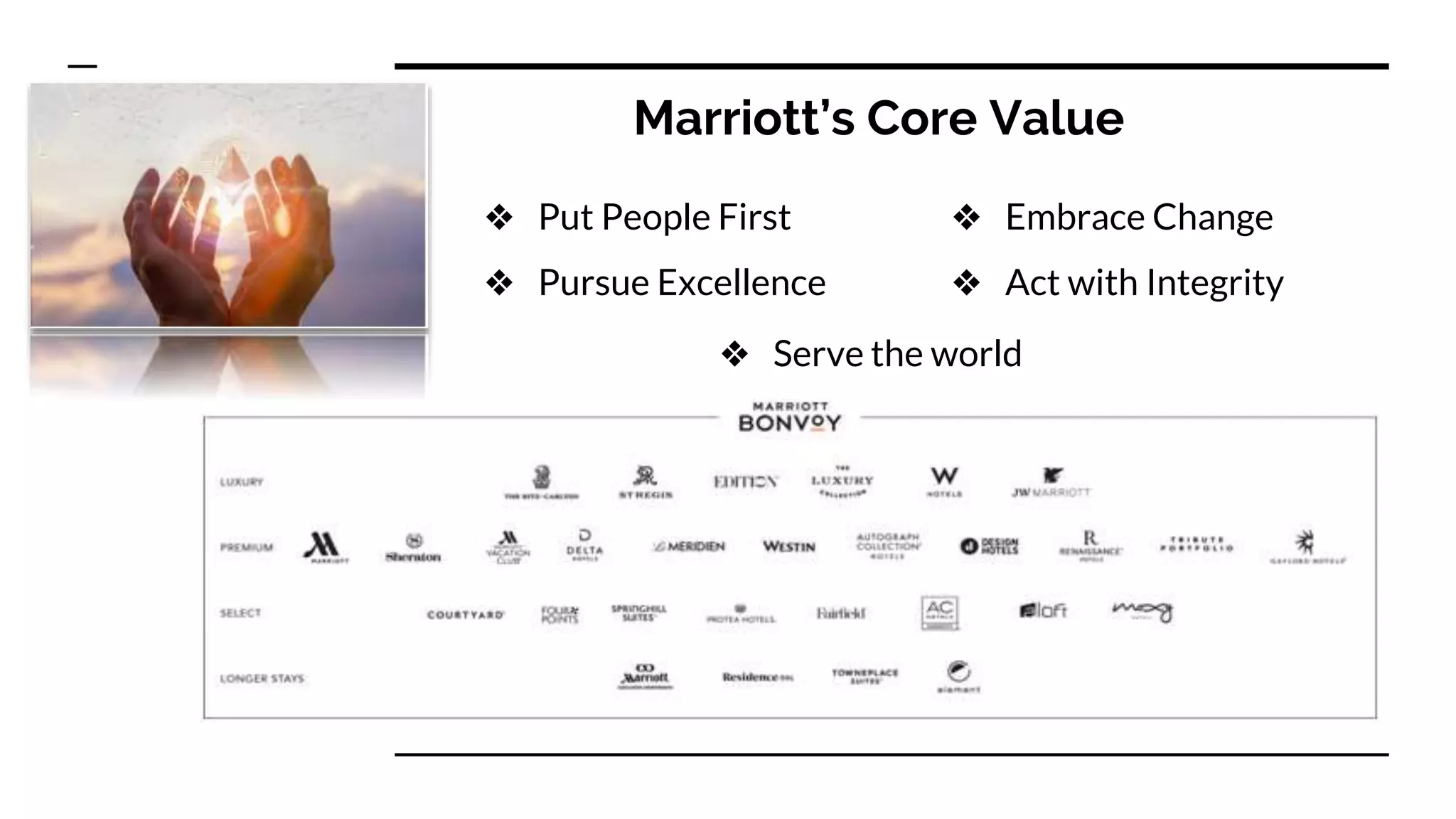
Marriott’s portfolio of 30+ brands is deliberately structured to “cover the entire spectrum of the hospitality industry”. Each brand has a defined identity and target market: – For example, Moxy Hotels target the budget-conscious, experiential young traveler with a chic, playful vibe; Westin emphasizes wellness and rejuvenation; W Hotels focus on design, music, and fashion for trend-setters; Autograph Collection and Luxury Collection gather unique independent hotels under soft brands appealing to boutique-lovers. Marriott’s marketing highlights these unique brand personalities in individual campaigns (like Westin’s “For a Better You” wellness campaign or Moxy’s cheeky social media content) so that each brand resonates with its intended audience. – At the same time, Marriott leverages category marketing.
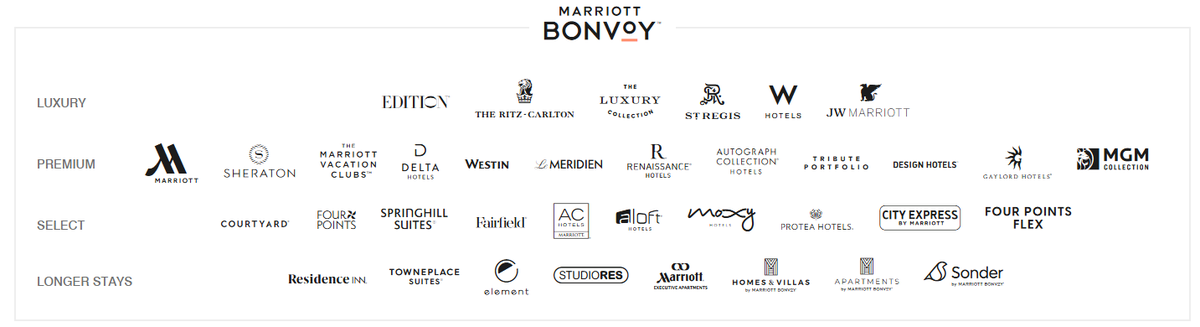
In 2017, it launched the “Golden Rule” campaign spanning four of its select-service brands (Courtyard, Fairfield, SpringHill Suites, and Four Points), emphasizing a collective value of treating guests with respect and care. This was a unified message for the select-service segment to strengthen those brands against mid-scale competitors. Similarly, Marriott’s “Room for Possibility” campaign in 2018 marketed its extended-stay brands together (Residence Inn, TownePlace Suites, Element) highlighting the spacious, homely feel of those hotels for long stays. – By segmenting its brands and marketing them appropriately, Marriott avoids a one-size-fits-all approach. Luxury travelers see aspirational storytelling for the high-end brands, while business travelers see productivity and consistency messaged for brands like Marriott Hotels and Sheraton. This way, Marriott captures various traveler demographics under one corporate roof.
Master Brand: Marriott Bonvoy
Post-2019, Marriott repositioned its master brand identity around Marriott Bonvoy, effectively making Bonvoy the consumer-facing brand encompassing all properties. This is evident in branding touchpoints – the Marriott Bonvoy logo now appears in advertising, on the Marriott credit cards, and even co-branded with events (e.g. “Marriott Bonvoy presents the NBA Global Games”). The strategy here is to make Marriott Bonvoy synonymous with travel rewards and experiences across all brands. As Peggy Roe, Marriott’s Chief Customer Officer, explained in a campaign release: “Being part of Marriott Bonvoy gives you access to a world that will help shape who you are forever”, positioning Bonvoy as the key to unlocking all of Marriott’s offerings. Thus, global campaigns now speak in the voice of Marriott Bonvoy – promoting the breadth of the portfolio (“30+ extraordinary brands”) and the promise that no matter where you travel, Marriott has a option for you. The tagline “Where Can We Take You?” exemplifies this, inviting guests to explore Marriott’s global map of hotels via the Bonvoy platform.
Consistent Brand Values
Even with many brands, Marriott’s marketing emphasizes a core set of values: quality service, trust, and innovation. Historically, Marriott built its reputation on consistent service (“Marriott” as a name implied dependable hospitality). Today, marketing for legacy brands like Marriott Hotels, Sheraton, and Renaissance still leans into reliability and meeting guest needs, but with a modern spin of innovation:
- “Travel Brilliantly” was a content-driven campaign for Marriott Hotels that invited guests to help co-create the future travel experience. Videos and articles showed Marriott experimenting with new ideas (like healthier vending options, tech-enabled meeting tables), thereby positioning the brand as forward-thinking while trustworthy. It conveyed that Marriott Hotels is not a stodgy business hotel chain, but an innovative partner in the traveler’s journey.
- Innovation and Adaptation: Marriott isn’t afraid to refresh brand images that grow stale. For example, Sheraton (one of Marriott’s biggest brands post-Starwood merger) underwent a marketing transformation around 2018 with new logos, lobby designs (“Sheraton flagship renovations”), and a campaign to shed its old-fashioned image. Marriott’s marketing team spoke of making Sheraton the “productivity hub” for modern business travelers, and rolled out ads highlighting new open lobby concepts and community spaces. This illustrates Marriott’s willingness to reposition brands to fit current market trends, backed by marketing communications to announce “new Sheraton” to the world.
- Local and Cultural Relevance: Globally, Marriott also tailors marketing to regional audiences to maintain cultural relevancy. For instance, in China, Marriott launched campaigns on local social platforms (WeChat, Weibo) and formed a joint loyalty venture with Alibaba’s travel arm to tap into the Chinese market. The messaging for Chinese millennials might highlight different aspects (like family travel deals during Lunar New Year or celebrity brand ambassadors) compared to what Marriott might emphasize in the U.S. or Europe. The company’s global marketing teams ensure that while the core brand promise is consistent, it speaks the local language – both literally and figuratively.
Brand Integration with Experiences
Another facet of Marriott’s branding strategy is associating brands with experiences and passions. For example, Marriott’s luxury brands are tied to themes of culture and well-being – The Ritz-Carlton’s marketing often involves the arts, culinary events, and community impact (Ladies & Gentlemen program), while Westin aligns with wellness trends (promoting their RunWESTIN jogging programs, sleep well initiatives). By integrating brand marketing with lifestyle content, Marriott positions its brands as more than just places to sleep – they are portrayed as integral parts of a traveler’s lifestyle or aspirations.
Marriott’s latest global campaign emphasizes transformative travel experiences across its portfolio. Developed with agency Wieden+Kennedy, the “You Are The Greatest Souvenir” campaign (launched 2025) showcases scenes from outdoor glamping to urban dining, illustrating how travel with Marriott Bonvoy’s brands leaves a lasting impact. This cinematic branding effort reaffirms Marriott’s positioning that it offers more than hotel stays – it offers experiences that shape who you are. Marriott’s branding increasingly taps into emotional storytelling, reflecting an evolution from product-focused ads to campaigns about personal transformation through travel.

Strategic Partnerships and Sponsorships
Marriott extends its marketing reach through a wide array of partnerships and sponsorships that align the brand with sports, entertainment, and other travel-related industries. These partnerships serve dual purposes: they increase Marriott’s brand visibility to new audiences and provide exclusive benefits or experiences to Marriott Bonvoy members, thus enhancing loyalty. Let’s explore some of Marriott’s most notable partnership initiatives and how they bolster the marketing strategy:
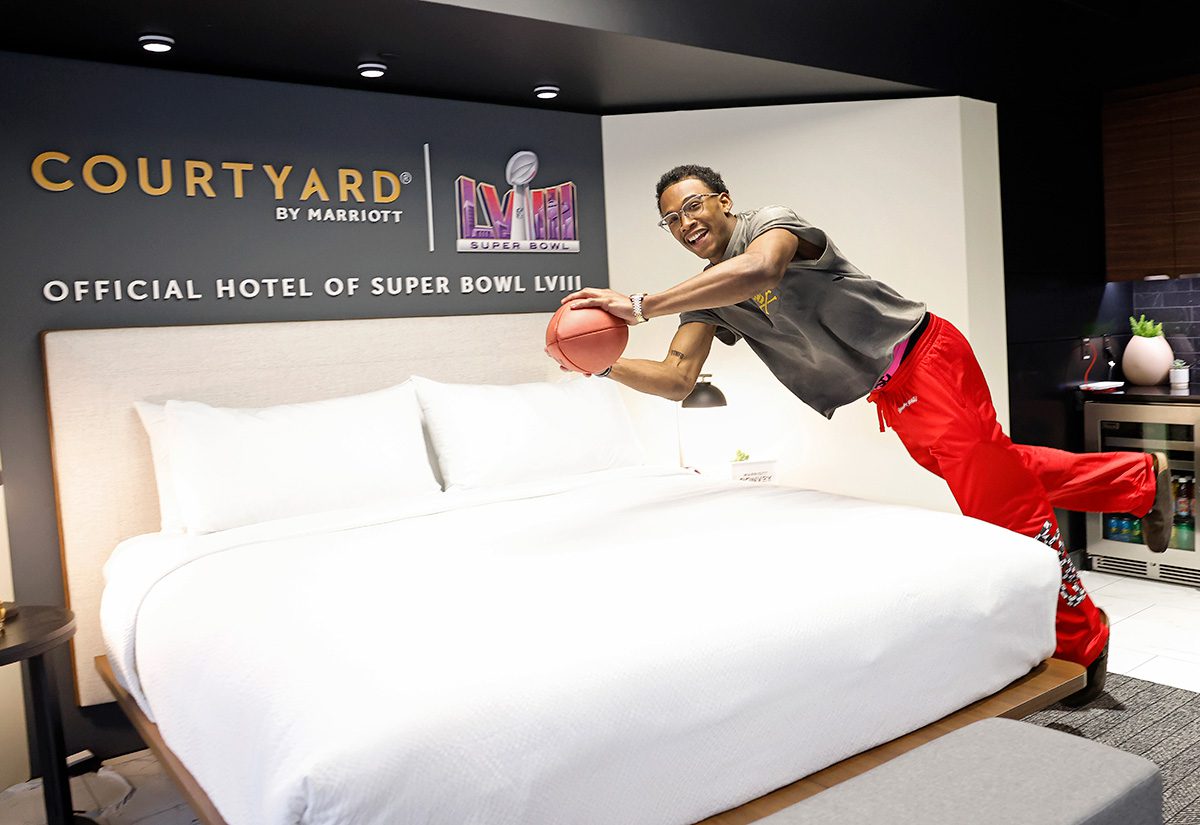
- Sports Sponsorships – NFL, NBA, and More: Marriott has deeply invested in sports marketing, recognizing that sports fans are a passionate and travel-prone demographic. Marriott International (often via the Courtyard by Marriott brand or Marriott Bonvoy directly) has been the Official Hotel Partner of the NFL for over 13 years. This long-term NFL sponsorship is activated through high-profile initiatives like the Courtyard Super Bowl Sleepover Suite, where a lucky fan wins a night in a custom-designed Courtyard hotel room inside the stadium during the Super Bowl. In the lead-up to the 2024 Las Vegas Super Bowl, Marriott created an “Ultimate VIP Weekend” for contest winners, including golf with NFL stars and VIP party access – these experiences generate buzz and are often only available to Bonvoy members, showcasing the program’s value. Marriott also hosts events at the NFL Draft and Pro Bowl, again integrating the brand with key fan moments.
Beyond the NFL, Marriott has partnered with the NBA and other sports. Marriott Rewards was an official partner of the NBA, and Marriott Bonvoy has continued engaging basketball fans, for example by sponsoring NBA Global Games events and offering meet-and-greet Moments with NBA players. In college sports, Marriott Bonvoy in 2023 became title sponsor of the Battle 4 Atlantis college basketball tournament in the Bahamas, renaming it the “Marriott Bonvoy Battle 4 Atlantis”. This partnership elevates Marriott’s visibility in collegiate sports and gives members special access (preferred seating, campus tours, etc.) at the event. These sports sponsorships are heavily promoted on Marriott’s channels – the Marriott Bonvoy NFL Travel Hub, for instance, markets how fans can earn points traveling to games and redeem points for NFL experiences.
Marriott has even ventured into Formula 1 racing sponsorships. In 2022, Marriott Bonvoy inked a partnership with the Mercedes-AMG Petronas F1 Team, leveraging the global popularity of F1. They hosted Bonvoy VIP events at Grand Prix races (like an exclusive “Rush After Dark” party in Miami with music artists and F1 drivers). By being present in F1 and international soccer (Marriott had a global marketing partnership with Manchester United from 2019 to 2022, which gave Bonvoy members access to VIP suites at Old Trafford), Marriott reinforces its brand among global sports fans. Crucially, these sports tie-ins feed Marriott’s content engine – videos of Bonvoy members enjoying these experiences become promotional content that Marriott shares, creating aspirational marketing that says: “See what being a Marriott Bonvoy member can get you!”
Entertainment and Music Partnerships
Marriott partners with entertainment companies to tap into pop culture moments. A notable collaboration in 2023 was Marriott Bonvoy’s partnership with Beyoncé’s Renaissance World Tour. Marriott offered exclusive concert packages and promoted the tour on its platforms, associating Marriott with one of the year’s biggest entertainment events.
Similarly, Marriott’s long-standing partnership with AEG Worldwide (the global sports and live entertainment company) connects Bonvoy with concerts, festivals, and events. This deal, renewed in 2022, means Marriott Bonvoy branding and member perks show up at events like Coachella, sports tournaments, and more. Members might redeem points for VIP passes to music festivals or backstage meet-and-greets with artists through Marriott’s Moments platform, a perk Marriott widely advertises to attract younger travelers who value experiences as much as hotel stays.
Travel and Lifestyle Partnerships
Marriott smartly partners with brands that complement travel. We discussed how linking with Uber and Starbucks extends Marriott’s reach into customers’ daily routines. Marriott also collaborates with airlines (e.g., United Airlines through the RewardsPlus program, giving reciprocal elite benefits to top-tier members) and with tourism boards on marketing campaigns to promote destinations where Marriott has a strong presence.
Another creative partnership is with credit card issuer Chase and Visa on the Marriott Bonvoy Bold and Boundless cards – beyond the card itself, Marriott and Visa have run joint promotions such as the “Marriott Bonvoy x Visa Late-Night Lounge” parties at major events (like the aforementioned NFL Super Bowl weekend party). These co-branded events boost Marriott’s image among affluent travelers and drive home the message that Marriott is at the center of travel, lifestyle, and fun.
Corporate and Cause Partnerships
Marriott also engages in cause marketing and corporate partnerships that reinforce brand values. For instance, Marriott has worked with the likes of TED (the conference and media organization) to bring TED Talks and speakers to Marriott Hotels, branding it as an enrichment for guests. In cause marketing, Marriott’s “Serve 360” initiative and partnerships with organizations like the Youth Career Initiative or WWF are sometimes highlighted in marketing communications, appealing to socially conscious consumers by showing Marriott’s commitment to communities and sustainability. While these are not direct revenue drivers, they contribute to brand trust and goodwill, enhancing Marriott’s overall reputation which in turn supports its marketing.
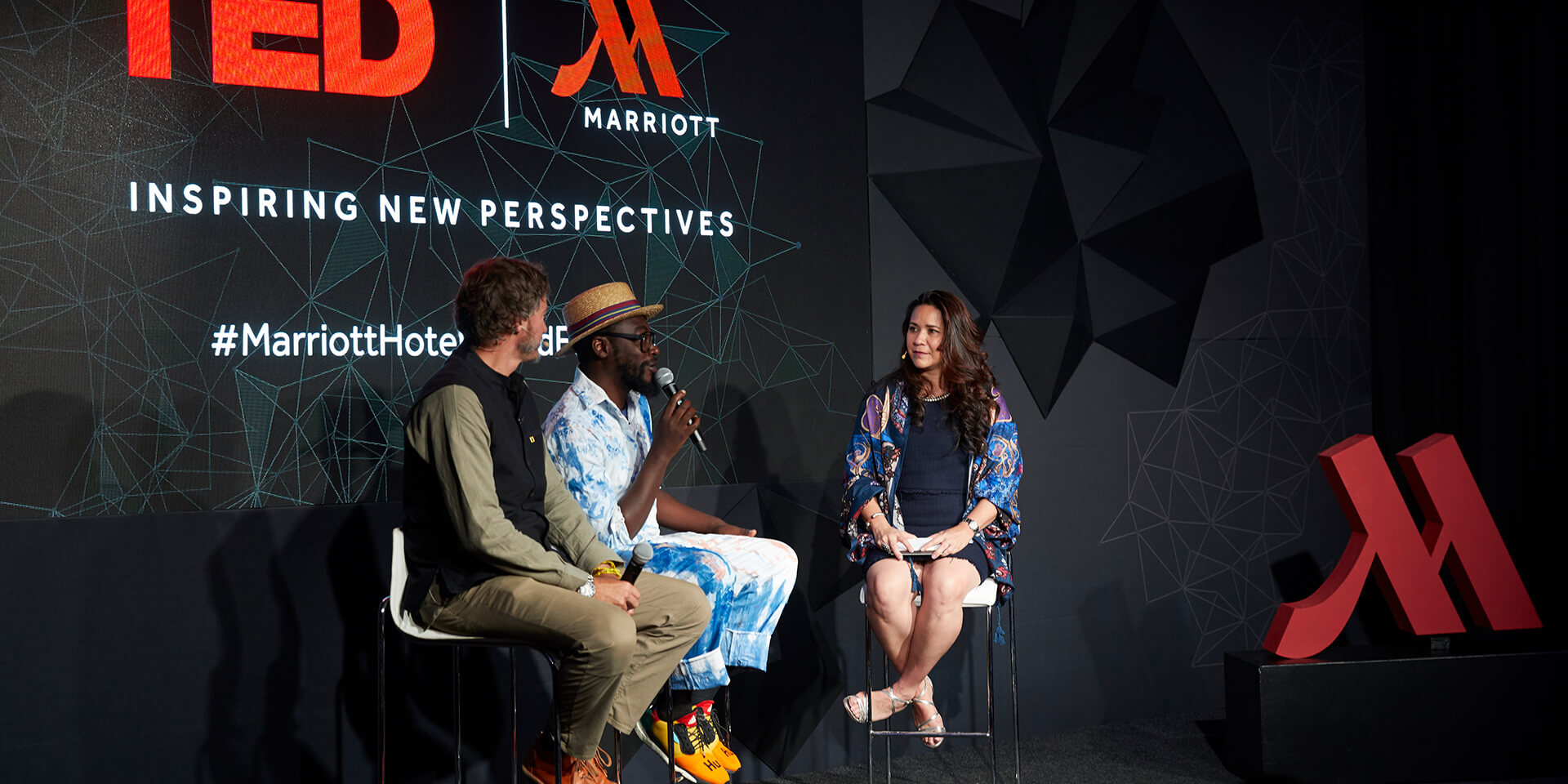
Why Partnerships Work for Marriott: These partnerships significantly amplify Marriott’s marketing in several ways: – They expand audience reach by placing Marriott’s brand in front of people who may not see traditional hotel advertising. A fan at a football game might see Courtyard signage or a Marriott Bonvoy logo on the event materials, prompting awareness. – They provide unique content and stories for Marriott to share. A video recap of a Bonvoy member’s once-in-a-lifetime experience (like sleeping in the Super Bowl stadium suite) is compelling content that gets shared on social media and press, acting as indirect advertising. – They add value to the loyalty program, making Marriott’s marketing of Bonvoy more enticing. It’s one thing to say “earn points for free nights,” but another to say “earn points and you could be at the next Super Bowl or rock concert, courtesy of Marriott Bonvoy.” That differentiation has marketing power, especially among younger travelers who crave novel experiences. – Many partnerships also come with cross-marketing agreements. For example, Marriott as an official hotel partner means leagues and teams mention Marriott in their fan communications (“…brought to you by Marriott Bonvoy”). This mutual promotion increases brand frequency.
Marriott’s savvy use of sponsorships underlines an important strategy: align your brand with passion points of your customers. By linking travel with sports, music, and culture, Marriott positions itself not just as a hotel provider, but as an experiential brand that enriches the lives of its customers. For hoteliers and marketers, Marriott’s partnership playbook demonstrates how to choose partnerships that both elevate brand image and drive tangible loyalty engagement.
Content Marketing and Social Media Mastery
Marriott is often hailed as a pioneer in content marketing in the hospitality space. Rather than relying solely on traditional ads, Marriott embraced a publisher mindset in the mid-2010s – creating engaging travel content to build brand affinity and keep consumers connected even when they weren’t booking a trip. Coupled with an agile social media strategy, Marriott’s content marketing efforts have been a core pillar of its marketing strategy.
Marriott Content Studio – Storytelling as Marketing
In 2014 Marriott launched a dedicated in-house content studio, bringing on talent from the media and entertainment industry. The mantra was “We’re a media company now,” as stated by David Beebe, Marriott’s then VP of Global Creative. This was a bold shift: Marriott started producing short films, web series, articles, and even VR experiences to engage travelers. Some standout projects from Marriott’s Content Studio: – “Two Bellmen” – a short action-comedy film series (the first released in 2015) set at JW Marriott hotels, featuring parkour athletes as bellmen who foil art thieves. It hardly felt like an ad; it was entertaining content that subtly showcased the hotel and its surroundings. The film was distributed on YouTube and even shown on in-room TV, garnering millions of views and generating PR buzz. – “Marriott Traveler” – an online travel magazine launched in partnership with Contently.
It features city guides, travel tips, and cultural stories, often not mentioning Marriott hotels overtly, but designed to inspire travel (and by extension, stays at Marriott). By providing valuable content, Marriott keeps potential customers on its site and builds credibility as a travel authority. – Documentary Series “The Power of Travel” – in 2023, Marriott Content Studio produced a series of documentary shorts following individuals using travel for personal change (covering themes like cultural connection and social impact). Notably, Marriott secured distribution for this series on Amazon Prime Video, a milestone that showed Marriott’s content is compelling enough for mainstream streaming. This series wasn’t directly promoting hotels; instead it elevated Marriott’s brand by associating it with meaningful storytelling about travel’s transformative power. The success (measured in high view-completion rates and positive engagement) demonstrated Marriott’s ability to reach audiences who avoid traditional ads.

The Content Studio’s approach is to engage consumers through storytelling first, building a relationship that eventually leads them to choose Marriott when they travel. As Beebe noted, “people aren’t engaging with traditional advertising” so Marriott shifted to content as a way to create value for the audience and nurture loyalty over time. This strategy has also given Marriott a wealth of owned media that it can use across channels – from YouTube videos to articles sharable on Facebook and Twitter.
Social Media Command Center – M Live
To complement content creation, Marriott invested in real-time social media engagement. It created M Live, a social media command center with large monitors tracking trending topics and brand mentions globally. Launched in 2015, M Live brought together departments like PR, social media, marketing, and even a media buying agency into one room, enabling quick decision-making on digital opportunities. One famous example of M Live in action: when a pair of Judy Garland’s ruby slippers were stolen from a museum and offered for ransom, the Marriott team saw the trend and jumped in – they quickly crafted a campaign offering 1 million Marriott Rewards points for information leading to the slippers’ return. With M Live’s rapid workflow (they collapsed a process that used to take months into days), Marriott turned a pop culture moment into a brand moment, generating millions of impressions.
M Live also empowers Marriott to surprise and delight guests. Arne Sorenson, Marriott’s late CEO, once shared how if a guest posts on social media about a Marriott stay, the M Live team might send a free dessert to their room or organize something special. This real-time responsiveness not only creates customer delight (which often gets shared online, becoming viral marketing) but also shows Marriott “listening” to customers. Sorenson championed social media as a way to build two-way loyalty – encouraging guests to share their experiences so Marriott can understand them better and personalize service. Marriott’s social media philosophy, summed up in Sorenson’s words, is “not to draw attention to ourselves, but to see our guests in their own spotlight” – meaning the focus is on amplifying guest stories rather than just broadcasting corporate messages.
Influencer and UGC Campaigns
Marriott was early to tap influencer marketing. For example, to attract millennials, Marriott created “Snapisodes” on Snapchat – short travel stories by influencers visiting Marriott properties. One such series had influencers document stays at new hotels (like the millennial-oriented Moxy brand) in a travel documentary style, but optimized for the Snapchat format (snackable, fun, and authentic). The content then flowed from Snapchat to YouTube and Facebook, extending its reach. Marriott found success because the content “barely resembles advertising” – it felt like following a friend’s journey. This helped Marriott reach a generation that shuns traditional ads and instead trust peer or influencer recommendations.
Additionally, Marriott’s #MarriottMoments campaign encouraged guests to share their favorite moments from Marriott stays on social media. By curating and reposting user-generated content (UGC), Marriott not only gained a stream of genuine, fresh content to use in marketing, but also built community among its guests. Travelers love recognition, and seeing their photo re-shared by Marriott’s official accounts can build loyalty. UGC also serves as social proof – real guests vouching for real experiences – which is immensely powerful marketing.
Multiplatform Presence and Experimentation
Marriott’s social media spans all major platforms:
- On Instagram, Marriott highlights beautiful travel imagery from its hotels and destinations, often through the lens of influencers or guests. It aligns with the aspirational nature of Instagram, effectively marketing the travel lifestyle Marriott enables.
- On LinkedIn, Marriott shares more about brand achievements, executive insights, and B2B content (appealing to owners, investors, and group travel planners).
- On Twitter (X), Marriott engages in customer service and quick updates, and brands like Ritz-Carlton have done hashtag campaigns (e.g. #RCMemories).
- On TikTok, Marriott has begun tapping into trends – for instance, Westin launched a TikTok challenge around wellness in travel, and some Marriott hotels use TikTok to showcase behind-the-scenes fun or local tips. Being present on TikTok helps Marriott stay relevant to Gen Z, using humor or viral sounds to subtly promote its properties.
Results and Impact
Marriott’s content and social media strategy has paid off in:
– Brand Affinity and Engagement: Consumers engage with Marriott’s travel content even when they’re not planning a trip, keeping Marriott top-of-mind for when they do plan. By providing value (entertainment, information), Marriott builds goodwill that pure ads might not.
– Media Coverage: Innovative efforts like the short films and M Live garnered media attention, positioning Marriott as a marketing innovator (which in itself is good PR within business circles and helps employer branding to attract top marketing talent).
– Conversions through Content: While hard to measure like a direct ad, Marriott has indicated that content-driven platforms like Marriott Traveler have led readers to click through and book hotels featured in articles. It’s a longer funnel, but it can drive high-intent traffic (if someone reads a Marriott Traveler guide to Paris, they might be inclined to book a Marriott hotel in Paris via links on the page).
For hospitality marketers, Marriott’s success here underscores the potential of content marketing: by telling great stories and harnessing social media interactions, a brand can transcend being seen as just a provider of rooms to being viewed as an authority and companion in the travel experience. Marriott effectively turned its marketing into a media operation, yielding a richer relationship with consumers that competitors have since tried to emulate.
Case Studies: Marriott’s Major Marketing Campaigns
Marriott’s marketing playbook includes several high-profile campaigns that illustrate its strategy in action. Here we highlight a few notable campaigns and initiatives, examining their objectives and impact:
“Travel Brilliantly” (Marriott Hotels brand, 2013-2015)
This campaign was a turning point for Marriott Hotels, the flagship brand. Aimed at modernizing Marriott’s image for a new generation of travelers, “Travel Brilliantly” presented Marriott as an innovative, experience-focused hotel. The campaign involved slick TV spots, a dedicated microsite, and a content platform soliciting ideas from travelers on how hotels can improve. Videos and social content under this theme showed travelers engaging in unique experiences facilitated by Marriott – local cultural adventures, high-tech amenities, creative meeting setups, etc.
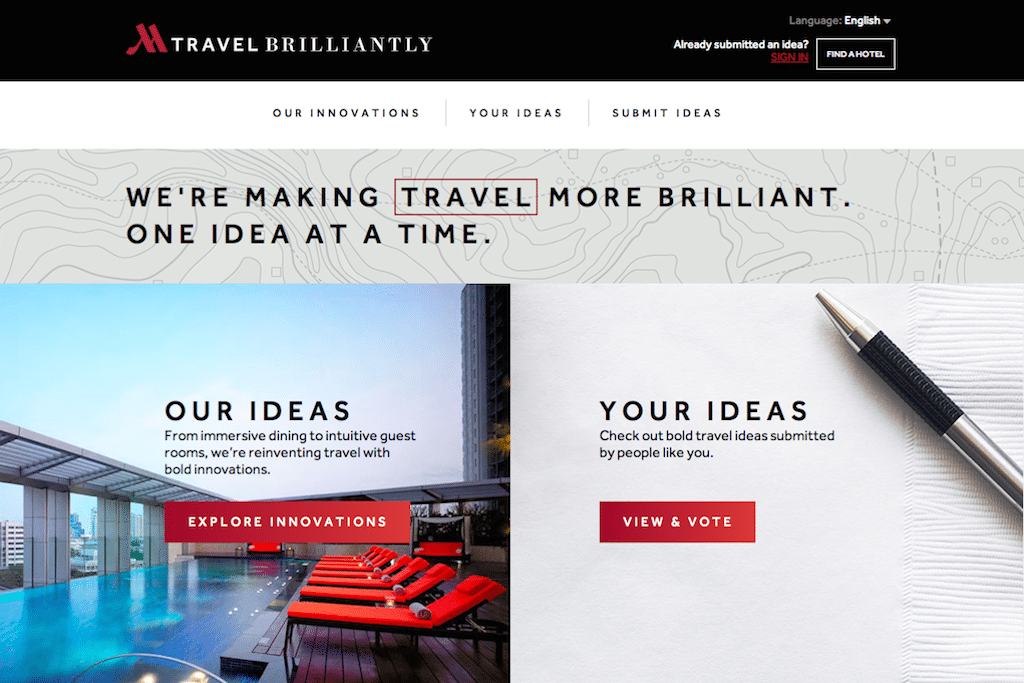
By emphasizing innovation and inviting guest interaction (e.g. crowdsourcing ideas that Marriott actually piloted, like healthier vending machines or in-room exercise options), the campaign repositioned Marriott Hotels from a traditional business travel brand to one that “pushes the boundaries of travel.” It also served as a content marketing trojan horse – the stories and ideas generated provided fresh material for blogs and PR. “Travel Brilliantly” succeeded in sparking conversation and gave Marriott valuable insight into customer desires, some of which influenced product development. The key lesson was Marriott’s recognition that marketing can double as R&D and brand rejuvenation.
Marriott Bonvoy Launch – “Rewards Reimagined” (2019)
When Marriott unified its loyalty programs into Marriott Bonvoy, it rolled out a global marketing campaign to introduce the new brand. The tagline “Rewards Reimagined” signaled that Bonvoy was more than a name change – it promised enhanced benefits and experiences. The campaign included a high-energy TV commercial featuring the word “Bonvoy!” being enthusiastically exclaimed in various travel scenarios, effectively trying to coin Bonvoy as the “new language of travel.” Marriott plastered Bonvoy branding on everything from billboards in major cities to digital ads, and leveraged its newly merged 120 million member database to send out Bonvoy launch communications. The campaign celebrated the breadth of Marriott’s portfolio (“letting you experience 30 brands with one program”) and the seamlessness of one unified account.

Internally, Marriott even encouraged employees and customers to use “Bonvoy” as a verb or greeting, to embed it in pop culture. While cheeky, it demonstrated Marriott’s commitment to building Bonvoy into a lifestyle brand. The launch was massive and not without hiccups (some tech integration issues and customer confusion), but from a marketing standpoint it achieved strong awareness – Bonvoy quickly became one of the most recognized names in travel loyalty. In fact, sign-ups accelerated post-launch, contributing to Bonvoy’s rapid membership growth. This case showed Marriott’s ability to execute a global rebranding campaign across dozens of countries in unison, a complex feat of marketing coordination.
“Where Can We Take You?” – Bonvoy App Campaign (2023)
As mentioned earlier, Marriott’s 2023 campaign focused on positioning the Marriott Bonvoy app as the ultimate travel companion. In the TV spot, viewers see a traveler scrolling the Bonvoy app and magically moving through scenes of different Marriott hotels – from a Westin workout to a W Hotel rooftop to a Moxy bar, etc., all set to the catchy tune of “Roam Around the World”.
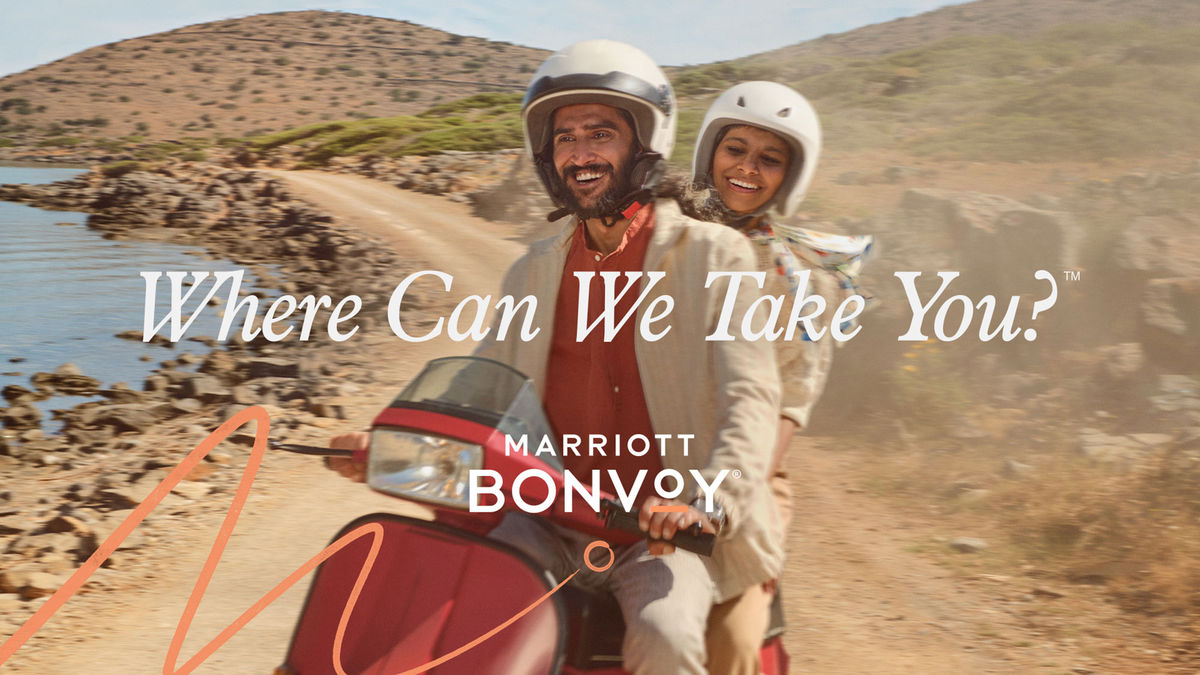
The ad ends with the question “Where can we take you?” – emphasizing Marriott’s range of brands and encouraging consumers to start their journey on the app. This campaign was a direct booking play wrapped in lifestyle imagery. Key takeaways from its success: it drove home the message that Marriott = variety and that the Bonvoy app is a gateway to that variety. It also subtly aimed to reduce OTA usage by showing the ease and appeal of browsing Marriott’s own app. Marriott reported that by highlighting the app and loyalty in such campaigns, they saw increased downloads and usage of the Bonvoy app, as well as growth in loyalty enrollments (since only members get the full benefits showcased).
Courtyard by Marriott’s “Golden Rule” (2017)
As mentioned previously, this campaign unified several Marriott brands under a simple message: “Treat others like you’d want to be treated”. Ads depicted heartfelt moments of hotel staff and guests going the extra mile for each other, underscoring hospitality’s human aspect. The campaign spanned TV, digital and even on-property posters across Courtyard, Fairfield, Four Points, and SpringHill Suites.
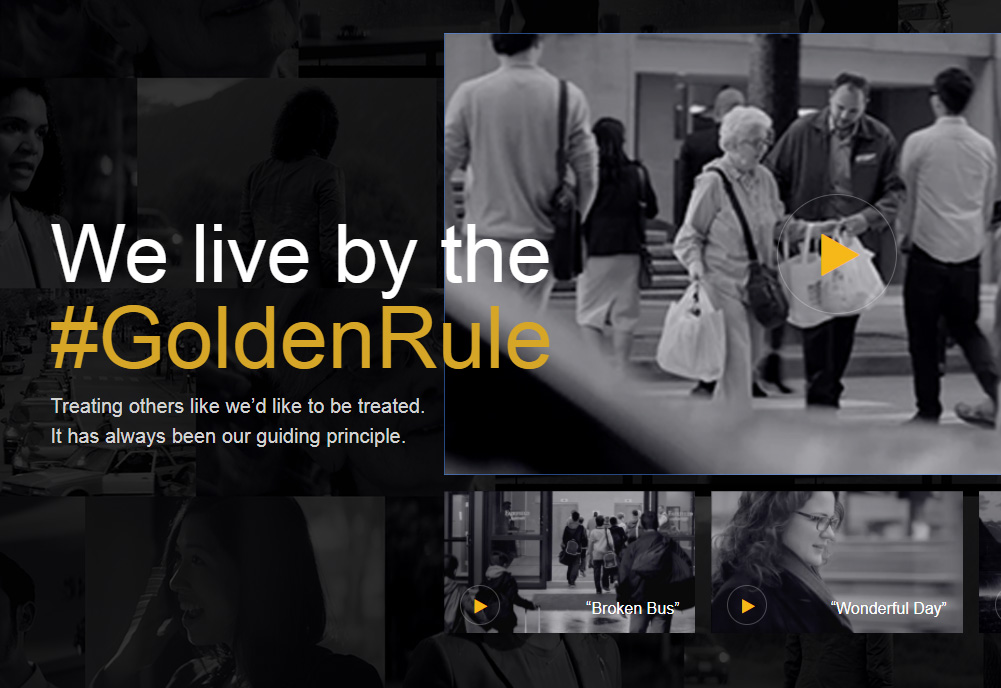
By focusing on a timeless principle, Marriott managed to humanize these mid-tier brands and differentiate them from competitors purely on service ethos. The “Golden Rule” campaign was well-received and helped improve brand perception for these properties. It’s a case where Marriott opted for a category message rather than individual brand ads, maximizing budget impact and creating a halo effect – if you saw one of these brands, you’d recall the warm feeling of the campaign applying to all.
Data-Driven Marketing and Personalization
Underpinning Marriott’s marketing success is a strong foundation of data-driven decision making and marketing technology. In the era of big data, Marriott has harnessed its vast customer information and analytics capabilities to personalize marketing, improve efficiency, and measure impact more rigorously. Let’s delve into how Marriott leverages data and technology in its marketing:
First-Party Data & Personalization
With over 230 million loyalty members, Marriott possesses one of the richest customer databases in travel. Every search, booking, and stay provides data points – from favorite destinations to spend patterns to traveler “passions”. Marriott uses this data to segment customers and tailor marketing content. For example, Marriott’s systems know if a Bonvoy member tends to book resorts for family vacations versus city hotels for business, and can target them accordingly (family package offers vs. double points on weekday stays). Chris Norton, Marriott’s SVP of Marketing Data & Personalization, explains that the goal is to take the data they know about customers and “make it useful – for them and for our partners”.
In practice, this means serving travelers relevant recommendations (showing a golf enthusiast resorts with great courses or suggesting hotels during a city’s food festival to a foodie traveler). The aim is marketing that feels like welcome personalization rather than intrusion. Marriott’s recent development of an in-house Marriott Media Network (piloted in 2022 and officially launched as “MARRIOTT MEDIA” in 2025) is a data-driven advertising platform that allows selected advertisers to target Marriott customers in a privacy-safe way.

By using 200+ attributes from Marriott’s data (e.g. demographics, travel intent, loyalty tier, etc.), an advertiser like an airline or retail brand can show offers to relevant travelers through Marriott’s channels. This not only opens a new revenue stream for Marriott, but it also enhances Marriott’s own marketing precision – effectively Marriott can cross-promote and create packages (like flight + hotel deals, or co-branded offers with, say, a luggage company to people with upcoming trips). The first-party data advantage Marriott has is hard for smaller competitors to match, and Marriott is clearly doubling down on using it responsibly to craft personalized marketing that “enriches, not interrupts” the customer journey.
Marketing Automation and Agility
A few years ago, Marriott undertook a major overhaul of its marketing operations to become more agile. They analyzed why a single campaign used to take 110 days from conception to launch – identifying 46 distinct processes and bottlenecks. By re-engineering workflows (likely through better project management systems, clearer governance, and more in-house production capabilities), Marriott condensed that timeline dramatically. Today, Marriott boasts that it can launch complex omnichannel campaigns in as little as 7 hours when needed. This is a stunning transformation that gives Marriott the ability to capitalize on real-time events or trends (for example, deploying a targeted flash sale if there’s a sudden drop in bookings due to a news event, or quickly rolling out a supportive message during a crisis).
The 2020 pandemic tested this agility – Marriott swiftly shifted its marketing to focus on health & safety (Cleanliness Commitment content, flexible cancellation messaging) and then pivoted again to “Ready to Travel” campaigns as soon as markets reopened. The investment in marketing automation tools (like Salesforce Marketing Cloud for email, programmatic ad platforms for digital, etc.) and integrated workflows means Marriott’s marketing team can coordinate global campaigns with consistent messaging yet local relevance. Norton described the new structure as showing up “with one voice to our customers – consistent and meaningful across every touchpoint”. Essentially, system integration ensures that what a customer sees in an email aligns with what they later see on social media or on Marriott’s website, creating a cohesive narrative driven by data triggers.
Measurement and Optimization
Modern marketing demands proof of ROI, and Marriott has embraced advanced analytics and attribution. Through its Marriott Media Network and other digital channels, Marriott can do closed-loop attribution – meaning if a customer sees an ad (for Marriott or a partner) on a Marriott channel and later makes a purchase, Marriott can tie those events together to measure the ad’s effectiveness. Marriott’s platform offers partners metrics like brand lift studies, attributable conversions, and even incrementality tests. I
nternally, Marriott uses multi-touch attribution models to allocate credit to various marketing touchpoints along the booking journey, helping optimize spend. For example, they might find that a combination of a social media video plus a follow-up email yields a higher booking rate than a display ad alone, informing future budget decisions. Norton has highlighted incrementality measurement as a key tool, saying it’s become their “greatest sales tool” in justifying marketing efforts. By focusing on outcomes like loyalty enrollment, retention, and revenue uplift, Marriott ensures its marketing investments drive tangible business results, not just vanity metrics like impressions.
AI and Emerging Tech
While not much public detail is given, Marriott, like its peers, is exploring artificial intelligence in marketing. Potential uses include AI-driven personalized recommendations (like what Amazon does, but for travel packages), chatbot assistance for sales (Marriott’s website and app have virtual assistants that can upsell or answer questions 24/7), and predictive modeling to anticipate travel demand.
Marriott’s revenue management systems have long used big data to optimize pricing (e.g. forecasting which nights will be high demand and adjusting rates), which is adjacent to marketing in ensuring promotions are timed and targeted correctly. Reports indicate hotel companies are betting on AI to improve loyalty engagement; for instance, Hilton and Marriott both have pilot programs using AI to customize offers and even to empower customer service agents with better guest insights. One example at Marriott: using AI to parse customer reviews and feedback to identify what amenities or messages resonate, then tailoring marketing copy accordingly by property or region. While still early, these efforts show Marriott’s commitment to staying on the cutting edge of martech.
Data Privacy and Trust
With great data comes great responsibility, and Marriott has learned that the hard way (notably a massive data breach inherited from Starwood in 2018). In marketing communications about the new Marriott Media Network, Marriott emphasizes that guest data is used in a consent-based, privacy-regulation-compliant manner. They’ve implemented easy opt-outs and are transparent about how data fuels personalization, aiming to build trust. For customers to welcome personalized marketing, they need confidence that their information is secure and used ethically. Marriott now often highlights its compliance with GDPR, CCPA, and other laws as a selling point when pitching its data-driven media capabilities to advertisers. In practice, Marriott’s marketing emails and app notifications also allow fine-tuned preferences, letting members select what kind of deals or news they want to hear about. This focus on privacy is not just legal compliance but a marketing stance – that Marriott respects its guests, reinforcing that Golden Rule ethos in the digital realm.
In summary, Marriott’s marketing is as much science as art. By building a strong data infrastructure and fostering a culture that uses insights at every step, Marriott has increased marketing effectiveness and responsiveness. The company’s ability to personalize at scale – delivering the right message on the right channel at the right time – significantly contributes to its competitive advantage. For marketing professionals, Marriott serves as a case study in the importance of a robust marketing tech stack and data strategy: from CRM to programmatic advertising to analytics, Marriott has invested in capabilities that allow it to act on data swiftly and craft more meaningful customer experiences.
Evolution of Marriott’s Marketing Approach (Past to 2024)
Marriott’s marketing approach has continuously evolved over the decades, especially in response to changing consumer behaviors and technological advancements. Looking back at the trajectory from the 2000s to 2024, we can observe a transformation from traditional marketing methods to a highly integrated, experiential, and digital-first strategy.
- Early 2000s – Traditional and Brand-Focused: Marriott’s marketing in the early 21st century was more traditional – print ads in travel magazines, broad-reach TV commercials, and a focus on individual hotel brands (e.g., Courtyard commercials targeting business travelers, Renaissance ads in lifestyle publications, etc.). The loyalty program (Marriott Rewards) was marketed in a straightforward way – earn points, get free stays – often via direct mailers and email without much personalization. Marriott’s messaging centered on reliability, quality service, and its growing footprint (“Over 3,000 hotels worldwide” type messages). Competitors like Hilton and Starwood similarly leaned on points and perks in their marketing, so there was a parity in approach.
- Mid/Late 2000s – Digital Beginnings: As online booking rose, Marriott shifted budget to digital channels. It launched the first Marriott mobile web and then app in 2008-2010 era, and started doing paid search. However, at this stage, digital was more a reservation tool than a marketing storytelling platform. The Marriott.com website was optimized for e-commerce, and the marketing team began focusing on online conversion metrics. Loyalty emails became more frequent. Yet, marketing campaigns were still largely product-centric – highlighting new hotels, new room designs (remember the “Revive” bed campaign for Marriott Hotels), and promotions like Marriott’s MegaBonus (stay X nights, get X points). Social media presence started in the late 2000s with simple brand Facebook pages and Twitter accounts primarily for customer service.
- Early 2010s – Enter Social and Experimentation: By the early 2010s, Marriott (under CEO Arne Sorenson from 2012) began to see the need to appeal to younger travelers and fend off emerging threats like Airbnb. Marketing became more experimental and social. We saw campaigns like “Travel Brilliantly” (2013) focusing on innovation, indicating Marriott’s recognition that it had to break the mold to stay relevant. Marriott Rewards started partnering with social media (e.g., offering bonus points for ‘checking in’ via Foursquare at hotels – a novel idea then). The company dipped toes in influencer marketing via bloggers and early YouTube travel personalities.
- Mid 2010s – Pioneering Content and Experiential Marketing: This was a watershed period. The launch of the Content Studio (2014) and M Live showed Marriott moving aggressively into modern marketing. Marriott had a first-mover advantage here; few competitors were doing anything similar at that scale. The marketing tone became more storytelling-driven. Campaigns like those short films and interactive promotions (like virtual reality postcards Marriott did in 2015, where they let people “teleport” to a Marriott resort via an Oculus VR experience in select cities) got Marriott noticed as an innovator. Additionally, Marriott’s historic acquisition of Starwood in 2016 was not just a business move but a marketing one – it acquired Starwood’s loyal customer base (and the beloved SPG program). Marketing in 2016-2018 had a huge focus on reassuring SPG members and integrating the programs. Marriott’s CMO at the time acknowledged SPG’s strength in building an emotional bond, something Marriott Rewards could learn from. Hence, marketing efforts like Marriott Moments (inspired by SPG Moments experiences) and more personalized elite communications were ramped up. By 2017-2018, Marriott was fully in on digital: increasing spend on social ads, producing YouTube series, using data for targeted offers, and encouraging direct bookings with Member Rates and campaigns that challenged OTAs.
- Late 2010s – Unification and Modernization: The rollout of Marriott Bonvoy in 2019 unified the loyalty brand and gave Marriott a fresh marketing platform. The campaign around it signaled a new era where Marriott would market one loyalty culture across all brands. We also see Marriott adopting more youthful branding – the term “Bonvoy” itself was a bit playful and modern. Marketing continued to highlight experiences more than the hotel room. For instance, a 2019 Bonvoy ad might show someone heli-skiing in Japan (with a subtle Marriott logo at the end) versus a 2005 Marriott Rewards ad that would have shown a family at a Marriott pool with a tagline about points. This shift to experience marketing was evident across Marriott’s brands and collateral.
- 2020-2021 – Crisis and Adaptation: The COVID-19 pandemic was a massive disruption. Marketing budgets were slashed industry-wide, but Marriott pivoted quickly to empathetic and informative messaging. Campaigns like “#TravelTomorrow” and “Reconnect with Travel” (aspirational messages to keep the dream of travel alive) were used while hotels largely focused on safety information. Marriott’s marketing in this period shifted to loyalty engagement without travel – promoting things like earning points via buying gift cards, using co-brand credit cards on everyday spend, or donating points to charity. The Bonvoy app and communications became tools to reassure guests (mobile check-in for contactless experience, etc.). Arne Sorenson’s heartfelt video message in April 2020 about the crisis, which went viral in business circles, also showed Marriott’s commitment to transparent, human communication – a form of PR and marketing that built trust.

As recovery began, Marriott targeted the surging leisure travel demand. They marketed work-from-hotel packages (Work Anywhere with Marriott Bonvoy) to capture remote workers, and staycation deals. The loyalty program marketing pivoted to emphasize flexible cancellations and extensions of elite status to retain customer goodwill. Essentially, the pandemic forced Marriott to become even more customer-centric in marketing, focusing on care and flexibility rather than salesy messages.
- 2022-2024 – Resurgence and Next-Gen Marketing: Travel came roaring back, and so did Marriott’s marketing campaigns, with some of the largest campaigns in its history launched during this time (as detailed, e.g., “Marriott For The Stay” – oh wait, that one is Hilton’s campaign; Marriott’s was the Bonvoy variety campaigns). In 2022, Marriott introduced more humor and pop culture – e.g., one ad featured celebrities (I recall Catherine O’Hara for Hilton’s campaign; Marriott might not have used celebs but did produce witty social content). The competition also heated up: Hilton’s 2022 “Hilton. For the Stay.” campaign directly poked at the fact that Hilton focuses on the stay vs. what they implied was Marriott focusing too much on the loyalty perks. In response, Marriott’s strategy didn’t directly engage in that spat; instead, Marriott continued emphasizing breadth of choice and experiences. The data-driven focus became very pronounced by 2023-2024. Marriott’s announcements of the Media Network and partnerships with ad tech signaled that it sees its future marketing as leveraging its customer data moat.
By 2024, Marriott’s marketing approach is a sophisticated blend of emotional branding, tech-enabled personalization, and loyalty-focused incentives. It’s far from the old days of one-size-fits-all hotel ads. Now, a Marriott marketing strategy for a quarter might include: a big aspirational campaign on TV/YouTube, hundreds of personalized email versions going to different customer micro-segments, social media influencer trips, real-time engagement via M Live for trending topics, and targeted promotions to drive specific behaviors (e.g., double points on resort stays to boost leisure bookings). It’s omnichannel and orchestrated as one system, as Norton described.
This evolution demonstrates Marriott’s ability to reinvent its marketing playbook continually. From print ads and brochures to augmented reality experiences and personalized Instagram replies, Marriott has traversed a long journey. Importantly, the company’s core marketing principle has endured: understand the customer deeply and meet them where they are. In earlier years, that meant understanding business vs. leisure segments and being in travel agencies or magazines they read. Today, it means understanding travelers’ individual passions and being on the digital platforms they use, with content they actually want to consume.
Marriott vs. Competitors: A Marketing Comparison
In the highly competitive hospitality industry, Marriott’s marketing strategy can be fully appreciated by comparing it to those of its main rivals – Hilton, Hyatt, and IHG (InterContinental Hotels Group). Each of these companies employs distinct tactics, though there are shared trends across the sector. Here’s how Marriott stacks up and where it differentiates:
Scale and Loyalty Programs
Marriott is the largest of the four, and its Marriott Bonvoy program is the biggest loyalty program in hospitality at ~228–237 million members. Hilton’s Hilton Honors has over 210 million members (and growing fast), IHG’s One Rewards around 100+ million, and Hyatt’s World of Hyatt about 50–60 million (but with very high engagement rates). All competitors have recognized the importance of loyalty marketing: – Hilton Honors similarly drives direct bookings by offering exclusive member discounts and heavily marketing their mobile app and digital key (Hilton was actually slightly ahead of Marriott in rolling out mobile key and check-in via app around 2014).
Hilton’s famous 2016 campaign “Stop Clicking Around” directly targeted OTA users by promising the lowest prices on Hilton.com for Honors members – a move Marriott and others followed with their own member rate pushes. Marriott’s approach was less in-your-face but effectively similar in giving Bonvoy members perks for booking direct. Both Marriott and Hilton now report over 50% of their bookings come from loyalty members, indicating these tactics succeeded in shifting share from OTAs to direct. – Hyatt’s World of Hyatt, while smaller in member count, is a cornerstone of Hyatt’s marketing. Hyatt takes a more high-touch loyalty approach – offering suite upgrades, club access awards, etc., that create a cult-like following among frequent travelers.
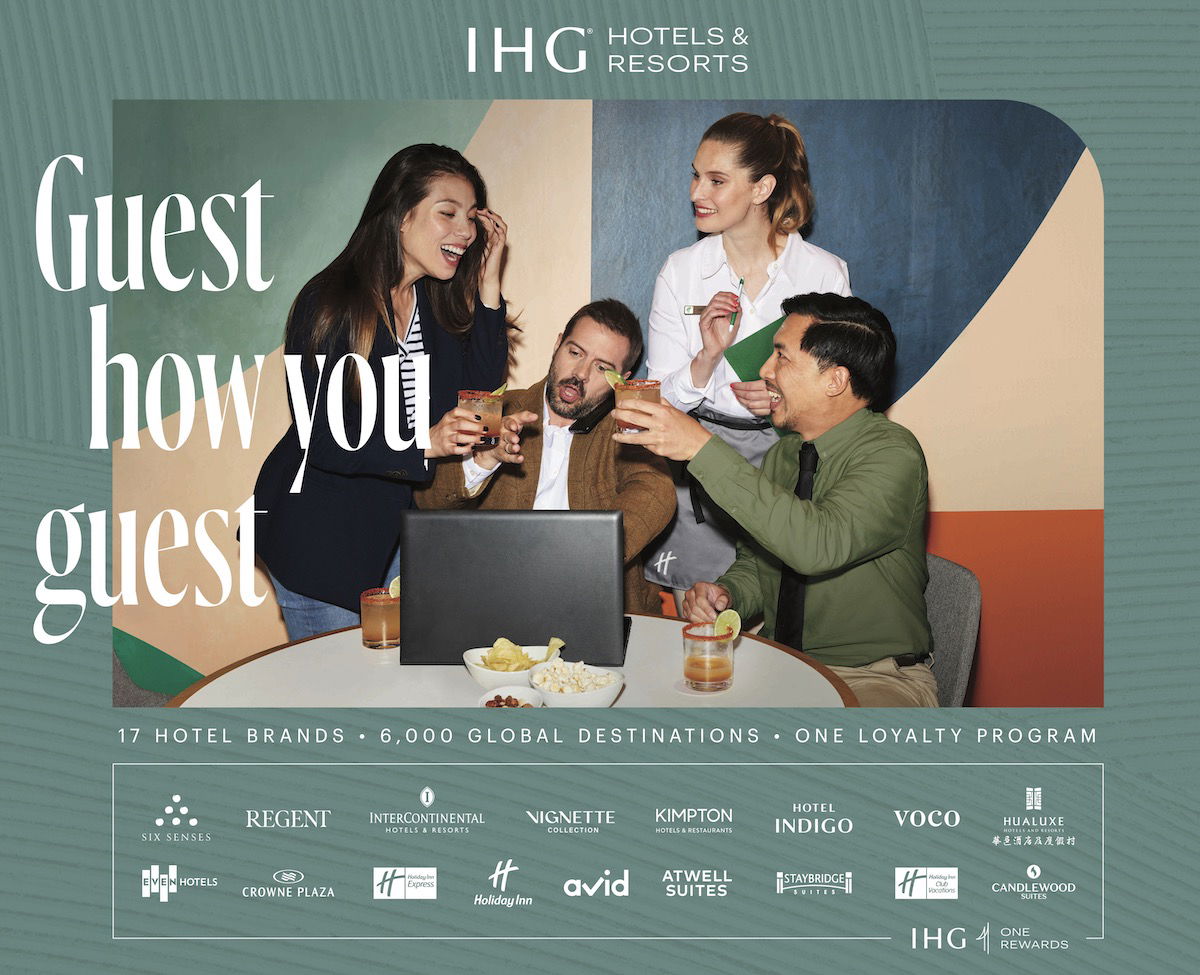
Marketing-wise, Hyatt appeals to emotions of belonging and understanding; their 2017 launch campaign for World of Hyatt was titled “For a World of Understanding” featuring real stories to position Hyatt as caring and inclusive. This is somewhat akin to Marriott’s 2025 “Travel Shapes Us” tone, but Hyatt did it on a smaller scale. Hyatt also integrates wellbeing into their loyalty marketing (e.g., offering members free meditation and mindfulness content through partnerships, given their acquisition of the Miraval brand). – IHG historically lagged in loyalty innovation but in 2022 relaunched IHG One Rewards with new perks (e.g., free breakfast for elites, milestone rewards) and a bold marketing campaign “Guest How You Guest” featuring actor Ben Schwartz in humorous situations to show that IHG’s got options for every travel style. This campaign was more comedic and informal, reflecting IHG’s attempt to shed a staid image and resonate especially with younger travelers. Marriott’s campaigns have tended to be more inspirational/aspirational than comedic, showing a difference in tone.
Brand Portfolio and Positioning: – Marriott vs Hilton
Marriott has 30+ brands to Hilton’s 18 brands (as of 2024). Both cover luxury to economy, but Marriott, after acquiring Starwood, has an edge in the luxury/lifestyle tier (with brands like St. Regis, W, Edition in addition to Ritz-Carlton) whereas Hilton has Waldorf Astoria, Conrad, and LXR at the top end. Marriott markets its broad portfolio extensively (the “Marriott Bonvoy – 30 brands” message), while Hilton’s marketing often emphasizes the consistency and recognition across its portfolio (“Every stay feels familiar and welcoming with Hilton”). For instance, Hilton’s 2022 “Hilton. For the Stay.” campaign used humor (like showing a family taking the hotel’s pillows home) to reinforce that Hilton understands the importance of the hotel stay itself, rather than distracting with other aspects. This was a subtle competitive dig – implying perhaps Marriott was focusing on experiences outside the hotel via Bonvoy. Marriott’s counterpoint would be that its broad portfolio enables those experiences. Both strategies have merit: Hilton zeroed in on core hospitality deliverables in its marketing, while Marriott aimed to encompass the entire travel journey. – Marriott vs Hyatt: Hyatt’s smaller size (about 1,200+ hotels vs Marriott’s ~9,000+) means Hyatt’s marketing focuses on quality over quantity. Hyatt often highlights its award-winning loyalty satisfaction and the uniqueness of its offerings (e.g., boutique brands like Andaz, Thompson Hotels, and partnerships like Small Luxury Hotels of the World which Hyatt members can book). Hyatt marketing campaigns, such as the recent “Be More Here” (2023) for their Hyatt Place/House brands, emphasize well-being and being in the moment – a relatively niche angle compared to Marriott’s broad strokes.
Where Marriott invests in huge media productions and global partnerships, Hyatt often invests in personal touches and targeted partnerships (e.g., Hyatt’s FIND experiences platform for members, or collaboration with Headspace for wellness content). Hyatt leverages its smaller scale as a selling point for personalization (“we know you by name”) which is a marketing contrast to Marriott’s boast of scale and variety. However, Hyatt has started to emulate some of Marriott’s moves: e.g., launching a content series about chefs at Hyatt hotels, increasing social media influencer stays, and ramping up digital direct booking offers. – Marriott vs IHG: IHG’s portfolio (17 brands after acquiring Kimpton, Regent, Six Senses, etc.) covers similar segments but historically IHG’s marketing was not as cohesive. Until recently, IHG Rewards was seen as weaker; thus IHG’s 2022 overhaul came with marketing that in many ways mimicked Marriott/Hilton’s successes – a flashy ad campaign, more perks, and a renewed push for direct bookings. IHG’s new slogan “Guest How You Guest” basically said “stay your own way, we have the brands and flexibility for you,” which parallels Marriott’s positioning of having something for every traveler. But IHG has less presence in luxury (aside from a few top brands) and relies heavily on its Holiday Inn and Holiday Inn Express mainstays, so IHG’s marketing spend is often concentrated on those flagship brands (for example, ads focusing on Holiday Inn Express’s tagline “Be the Readiest” with humorous vignettes). Marriott, by contrast, tends to market the corporate brand and loyalty program more and let individual hotels market themselves with guidance.
Conclusion: Key Takeaways from Marriott’s Marketing Masterclass
Marriott’s marketing strategy is a multifaceted blend of innovation, customer-centricity, and consistent execution. By diving deep into digital marketing, nurturing one of the world’s largest loyalty programs, creating emotional brand narratives, leveraging high-impact partnerships, and relentlessly using data to refine tactics, Marriott has set a high bar in hospitality marketing.
For marketing professionals and hoteliers, Marriott’s approach offers several actionable lessons:
- Build a Loyalty Ecosystem, Not Just a Program: Marriott Bonvoy demonstrates that a loyalty program can be the engine of marketing, driving direct bookings, providing rich customer data, and forming the basis for partnerships. Investing in your loyalty scheme – simplifying it, adding unique rewards, and aggressively enrolling customers – can pay off in both customer retention and marketing ROI. Marriott turned Bonvoy into a lifestyle brand; others can consider how to make their loyalty program integral to their brand identity.
- Embrace Content and Storytelling: Rather than relying only on price and product, Marriott sells experiences and inspiration. Creating a content hub or a storytelling campaign can differentiate your brand and keep customers engaged between purchases. Marriott’s Content Studio shows that dedicating resources to creative content (be it blogs, videos, podcasts) can strengthen brand love and organically attract customers. Find the authentic stories within your brand and tell them – this builds a connection that traditional ads may not.
- Leverage Digital & Data for Personalization: Marriott’s success is heavily tied to its digital prowess – a user-friendly app, strong SEO/SEM presence, and personalized communications. Modern travelers expect convenience and relevance. Ensure your website and app are optimized for seamless booking and engagement. Use customer data to tailor offers (even simple segment-based emails like “We miss you” for lapsed customers or special perks on birthdays can make a difference). Also, keep exploring upcoming tech – whether AI for chatbots or new social platforms – to stay ahead. As Marriott showed with its marketing transformation (110-day campaigns down to 7 hours), agility is key. Streamline your marketing operations so you can respond in real time to opportunities.
- Strategic Partnerships Amplify Your Brand: Marriott partners with powerhouse brands (NFL, airlines, credit cards) that align with travel. Consider partnerships or sponsorships that make sense for your audience – they can extend your reach and add excitement to your marketing. The key is authenticity and mutual value. Marriott offers its partners access to a huge audience, and in return gets content or experiences (like exclusive events) that fuel its marketing. Even at a smaller scale, a hotel might partner with a local tour company or event to create a unique package, then market that to stand out.
- Consistent Global Branding with Local Relevance: Marriott maintains a strong global brand message (e.g., travel enriches you, Marriott has something for everyone) while empowering local marketing teams to adapt to cultural nuances. The takeaway: have a clear core brand promise and visual identity, but allow flexibility to speak to different segments or regions in a way that resonates. This ensures consistency (important for brand trust) without being tone-deaf or irrelevant in local contexts.
- Measure and Adapt: Finally, Marriott’s use of data to measure campaign performance and customer feedback is a reminder that marketing should be an iterative process. Set KPIs (like direct booking growth, social engagement, or loyalty sign-ups) and monitor them. A/B test your campaigns on a smaller scale if possible and learn from the results. Marriott’s willingness to evolve – whether merging programs, trying new ad channels, or even pulling back when something doesn’t work – is something to emulate. The market and consumer preferences are always changing; a great marketing strategy is never static.
Marriott’s journey from a traditional hotel advertising approach to a sophisticated, experience-led marketing powerhouse didn’t happen overnight. It required leadership vision, willingness to invest in new ideas, and a strong alignment between marketing and overall business strategy. The payoff is evident in Marriott’s brand strength and customer loyalty metrics today.
As we move beyond 2024, Marriott is likely to continue breaking new ground – perhaps integrating more AI-driven personalization, pushing the envelope in sustainability marketing (an area all hotel companies are increasingly highlighting), and finding novel ways to connect with Gen Z travelers. For industry professionals, keeping an eye on Marriott’s marketing moves will provide inspiration and insight into the next chapter of hospitality marketing.