

In today’s hospitality landscape, effective marketing can make the difference between a thriving hotel and an empty lobby. Travelers are more connected and informed than ever – a whopping 84% of travelers start their journey by researching destinations online. Social media feeds, search engines, and travel blogs have replaced traditional brochures as the first touchpoints for potential guests. This means that hotel owners must meet their audience where they are: in the digital realm. Modern hotel marketing isn’t just about putting up a billboard or listing on an OTA; it’s about crafting a multi,channel presence that engages guests at every stage, from inspiration and research to booking and beyond.
What does this look like in practice? It means a beautiful, mobile,friendly website, active social media profiles, engaging content that tells your hotel’s story, and personalized communication that makes each guest feel valued. It also means navigating intense competition. Online travel agencies (OTAs) like Booking.com and Expedia pour enormous resources into marketing (Expedia spends roughly 20–30% of its revenue on marketing), making it hard for individual hotels to stand out. Meanwhile, traveler expectations keep rising – guests crave authentic experiences, quick responses, and seamless digital interactions.
Hotel marketing today is fast,paced and data,driven. Successful hoteliers leverage technology and customer insights to target the right audience with the right message at the right time. For instance, if you know a large portion of your guests are young travelers who discover hotels on Instagram or TikTok, you’ll focus on visual social content. If business travelers are your bread and butter, you might invest in LinkedIn content or Google Ads targeting conference keywords. The key is to be proactive and strategic: rather than relying on travelers to stumble upon your property, you actively reach out, engage, and guide them toward choosing your hotel.
In short, marketing in the hotel industry has evolved from a supporting role to a central pillar of business success. It’s not just about advertising a room; it’s about building relationships. By embracing the latest tools and strategies (which we’ll dive into below), even independent hotels can compete on a global stage and attract guests from across the world.
The Importance of Digital Transformation in Hospitality
The hospitality industry has undergone a digital revolution in the past decade, and the pace isn’t slowing. Digital transformation – the integration of technology into all aspects of hotel operations and marketing – is no longer optional; it’s an essential strategy for survival and growth. Hotel owners who once relied solely on traditional channels are finding that today’s guests live on smartphones and social networks, and expect hotels to be just as tech,savvy. Embracing digital tools can dramatically improve a hotel’s ability to reach and serve guests.

One clear example of digital transformation is the drive for more direct online bookings. Hotels have realized that when a guest books direct via the hotel’s website or app, the hotel keeps more of the revenue (saving the ~15–30% commission charged by OTAs). Direct bookings not only improve margins (one analysis found hotels earn 9–20% higher profit per booking when it’s direct) but also let you own the guest relationship (and data) from the start. That’s why many brands have doubled down on digital marketing to shift customers away from intermediaries. For instance, Hilton’s famous “Stop Clicking Around” campaign was a massive digital initiative encouraging travelers to book direct by offering loyalty perks and guaranteed lowest rates. The result? Hilton saw a record surge in direct bookings and a faster,growing share of web business, with web direct channels growing five times faster than OTA bookings that quarter. This success story underlines how a bold digital strategy can transform a hotel’s revenue mix.
Digital transformation in hospitality also means enhancing the guest experience through tech. Hotels are adopting CRM systems, mobile apps, AI chatbots, and smart room features to meet guest needs in real time. From a marketing perspective, these technologies provide valuable data and new communication channels. For example, mobile check,in apps and Wi,Fi login portals can capture guest emails and preferences (with consent), which feed into more personalized marketing later. Modern CRM platforms unify data from various touchpoints so that your marketing emails and ads can be tailored to each guest’s history and interests. As a hotel owner, leveraging these tools lets you segment your audience and target them with precision, rather than blasting out one,size,fits,all messages.
Another aspect of digital transformation is keeping up with emerging consumer behaviors and platforms. Consider the explosion of short,form video and influencer,driven discovery. Travelers are now using platforms like TikTok, Instagram, and YouTube as primary sources for finding travel inspiration (Sabre Hospitality reports that globally 35% of travelers use social media and video platforms to discover their next destination, reflecting how critical these channels have become). If your hotel isn’t visible on these platforms – through organic posts, influencer partnerships, or video content – you risk being invisible to a large segment of potential guests.
Importantly, digital transformation is not just about marketing outwardly, but also about listening and responding to feedback online. Managing online reviews on sites like TripAdvisor, Google, or Yelp is a crucial part of a hotel’s reputation management. A hotel with a modern mindset treats every review as marketing: respond promptly and helpfully, and you demonstrate your customer,centric values to every potential guest reading those reviews. (Many experts recommend responding to 100% of negative reviews and at least half of positive reviews to show that you care.)
In summary, the hospitality industry’s digital transformation is leveling the playing field and opening new opportunities. An independent boutique hotel with a smart digital strategy can outrank a big brand in local SEO, charm thousands on social media, or cultivate loyalty through personalized emails – all by using accessible technology. The investment in digital tools and skills pays off by increasing efficiency, expanding reach, and deepening guest loyalty. Next, we’ll explore specific strategies across key digital channels to help you capitalize on this transformation.
Hotel Social Media Marketing Strategies
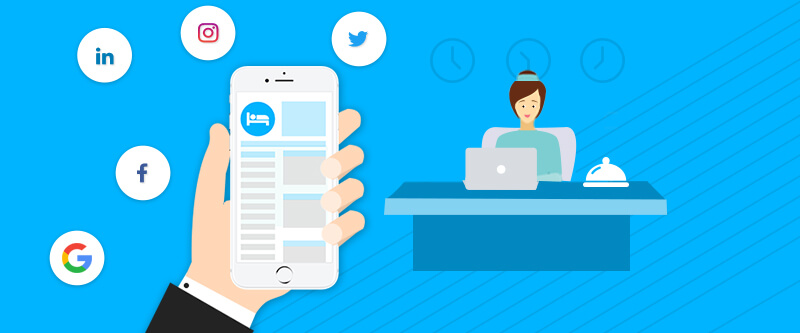
Social media has become a powerhouse in hotel marketing – it’s often where the first spark of travel inspiration happens. Think about the last time you saw a breathtaking resort photo on Instagram or a funny hotel TikTok; social platforms are influencing travel decisions at scale. In fact, 42% of consumers say social media influences what and where they purchase (including travel choices). For hotel owners, this is a golden opportunity to engage guests, build your brand personality, and even drive direct bookings, all while fostering a community around your property.
So, how can you leverage hotel social media marketing effectively? Here are some actionable strategies and tips:
- Choose the Right Platforms: Focus your energy on the social networks that align with your target audience. For example, Instagram and TikTok are fantastic for visual storytelling – showcasing your beautiful rooms, amenities, and local scenery in photos and short videos. Facebook is useful for building a community, sharing news and events, and engaging an older demographic. Twitter (or X) can be used for quick updates or customer service interactions. If you cater to professionals or event planners, LinkedIn might even be relevant. It’s better to have a strong presence on a couple of key platforms than a weak presence everywhere.
- Share Engaging Visual Content: Social media is a visual medium, especially for travel. Invest time in high,quality photos and videos that highlight what makes your hotel special. Show off the infinity pool at sunset, the cozy fireplace in your lobby lounge, or the view from your rooftop bar. Don’t just post generic room photos – tell a story with each post. For instance, create a 30,second video of a “day in the life” at your hotel: morning coffee in the café, a peek into housekeeping setting up a welcome gift, guests enjoying a local tour, and ending with a relaxing spa scene at night. These narrative,driven visuals make followers imagine themselves at your hotel, which is exactly what you want. It’s no surprise that short,form video now dominates discovery – videos under 90 seconds keep about half of viewers watching till the end, outperforming static images. Hotels can capitalize on this by posting quick room tours, behind,the,scenes clips of your chef preparing a dish, or guest testimonials in video form. And remember to add captions or text overlays, as many users watch videos with the sound off (especially important on platforms like Instagram Reels).
- Leverage Hashtags and Geotags: Make your content discoverable. Use popular travel and location,based hashtags (e.g., #LondonTravel, #BeachResort) alongside your branded hashtag (if you have one). Geotag your posts with your location so that people searching that destination see your content. For example, if someone searches for posts tagged in your city, your beautiful hotel images should appear. This is an easy, free way to boost exposure to travelers already interested in your area.
- Encourage User,Generated Content (UGC): One of the most powerful social media strategies for hotels is to get your guests to do the posting for you. Encourage guests to share their experiences on their own social media and tag your hotel. You might create an “Instagrammable” spot on your property (like a colorful mural or a scenic viewpoint) and use signage or gentle prompts like “Share your #SunnySideHotel moments with us!” When guests create content, reshare (repost) their best photos or stories (with permission and credit). UGC not only provides you with a steady stream of authentic content, it also acts as word,of,mouth recommendations to everyone in those guests’ networks. People trust other travelers more than advertising, so seeing real guests having a great time at your hotel builds credibility. Some hotels even run social media contests (e.g., “Post a photo of your stay and tag us for a chance to win a free night!”) to spur UGC. Just ensure you follow platform rules and local regulations for contests.
- Partner with Influencers (Smartly): Influencer marketing isn’t just for big brands – even boutique hotels can benefit from it. The key is finding the right influencers. You don’t need a celebrity with millions of followers; often a micro,influencer or nano,influencer (with a smaller but highly engaged following) can be more effective for niche targeting. Look for travel bloggers, photographers, or lifestyle influencers whose audience matches your target market (for example, a family travel blogger if you are a family resort, or a foodie Instagrammer if your hotel has a notable restaurant). Invite them for a complimentary stay or experience in exchange for them sharing honest content about your hotel. When Starwood launched two new hotels in Paris, they hosted five popular travel Instagram influencers to generate buzz – the influencers posted stylish shots of the hotels and local culture, reaching hundreds of thousands of potential guests. Starwood even integrated a booking tool on Instagram so viewers could directly book from the posts. The result was a noticeable boost in social followers (their Instagram grew past 500k) and increased inquiries from the influencers’ home markets. The lesson: influencers can provide beautiful content and authentic endorsements that build emotional connections with your audience. Just be sure to choose influencers whose style and values match your brand, and always outline expectations clearly (how many posts, which platforms, etc.) to avoid misunderstandings.
- Humanize Your Brand: Use social media to show the people and personality behind your property. Highlight your staff – do a post introducing your concierge with their favorite local tip, or a mini,interview with your chef about that day’s fresh ingredients. Behind,the,scenes content, like setting up for a wedding or prepping a new menu, makes your followers feel like insiders. This human touch is important because hospitality is all about people. Kimpton Hotels, for example, ran a “Stay Human” campaign focusing on heartfelt, real stories from staff and guests, showcasing diverse and authentic experiences – it struck a chord and generated billions of impressions as travelers appreciated the honesty[17]. You don’t need a big campaign to do this; simply posting genuine moments (with permission when guests are involved) can go a long way in building trust and likability.
- Engage and Respond: Social media is a two,way street. Don’t just publish content – actively engage with your audience. Respond promptly to comments and messages, whether they’re compliments, questions, or concerns. If someone comments, “This view looks amazing!”, you might reply, “It’s even better in person – we’d love to host you one day!” If a user asks about rates or availability in a comment, politely direct them to your booking link or DMs to continue the conversation. Also, keep an eye on people mentioning your hotel (tagging or even just naming it without tagging). On platforms like Twitter or Instagram, you can search your hotel name to catch posts you’re not tagged in. Engaging with users who talk about you (e.g., thanking someone for a nice review they tweeted, or addressing a complaint) shows that you’re attentive and care about guests beyond the checkout. Responsiveness on social media is actually a form of customer service, and great service is great marketing.
- Social Media as a Booking Channel: A newer trend is turning social platforms into direct sales channels – often called social commerce. Hotels can now enable booking buttons or “swipe up” links on platforms like Instagram, Facebook, and even TikTok, allowing users to book a stay directly through the app. Consider using features like Instagram’s action buttons or integrating your booking engine with Facebook. At minimum, ensure your social profiles have an up,to,date link to your booking site or a “Book Now” call,to,action. Reducing the friction in moving from inspiration to reservation can significantly boost conversions. For example, an enticing TikTok video of your pool could end with a on,screen text like “See more or book now – link in bio,” funnelling that interest straight into a booking page. Some hotels report that allowing bookings through social DMs or chat has also helped capture impulsive travelers who see something they like and want to act on it immediately.
- Paid Social Campaigns: While building an organic presence is crucial, consider amplifying your reach with targeted social media ads. Platforms like Facebook and Instagram have incredibly detailed targeting options – you can show ads to users based on location, interests, travel intent, demographics, etc. For instance, you could run a campaign targeting people aged 25,40 in a neighboring state who have shown interest in “weekend getaways” or “beaches,” featuring a special weekend rate at your resort. Social ads can be used to promote limited,time offers, new amenities, or seasonal packages. The advantage is you’ll reach beyond your follower base to new potential guests. Measure the results (each platform provides analytics) and refine your targeting or creative as you learn what resonates.
- Monitor and Manage Reputation: Social media isn’t just Facebook and Instagram – it also includes review sites and forums where people socialize opinions. TripAdvisor, Google reviews, and Facebook reviews are highly influential for hotels. An aspect of social marketing is reputation management: actively monitor these platforms and respond to reviews. Thank guests who leave positive reviews (“We’re thrilled you enjoyed your stay – hope to welcome you back!”) and professionally address negative ones by apologizing and offering to resolve the issue. Not only does this directly repair relationships, but it shapes the narrative for anyone else reading. A potential booker who sees that you respond to feedback will feel more confident that you care about guests. This ties into social media because these reviews often show up on social profiles or are considered part of your online social presence. Plus, reviews themselves are content – a form of user,generated content. By improving guest experience and encouraging reviews, you indirectly improve your “social proof” marketing.
Real,world example: A legendary case study in hotel social media marketing is the Hans Brinker Hostel’s “Worst Hotel in the World” campaign, which shows the power of going against the grain. This budget hostel in Amsterdam embraced its faults with humor – posting cheeky ads and social content that boasted things like “Now Free Toilet Flushing” or “Now Even More Noise!” as if they were features. The tongue,in,cheek honesty went viral and actually attracted young travelers who appreciated the authenticity and comedy. The hostel gained worldwide attention and carved out a unique brand identity without spending lavishly. The lesson here is not that you should call your hotel bad, but that authenticity and knowing your audience are key. Hans Brinker knew their backpacker audience would laugh at rough edges, and they turned those into a marketing asset.
Examples of Hans Brinker Hostel’s infamous “worst hotel” ads, using humor and honesty as a marketing hook. By openly highlighting their flaws (like rooms without windows or extra noise), they created a tongue,in,cheek brand image that resonated with budget travelers seeking a fun, authentic experience.
To wrap up, social media marketing for hotels is all about storytelling and engagement. Be visual, be responsive, be authentic. Show potential guests what makes your property and location special, and let your brand’s personality shine. If you can spark a conversation or an emotional reaction (whether awe at a sunset or a chuckle at a witty tweet), you’re one step closer to converting that viewer into a guest. In the age of social media, every hotel can be its own media company – so start broadcasting your unique story to the world.
Hotel Email Marketing Campaigns
While social media tends to get the glamor and spotlight, email marketing remains one of the most powerful tools in a hotel’s arsenal. In fact, hotel email marketing often delivers the highest ROI of any marketing channel – some industry statistics claim an average of $36 revenue for every $1 spent on email campaigns. Why? Because email is personal, direct, and targeted. It’s a channel where you communicate one,on,one with guests and prospects who have already expressed interest in your property (by signing up or booking). For hotel owners, mastering email marketing means you can drive repeat bookings, nurture guest loyalty, fill in low seasons, and promote your offerings at virtually no marginal cost.
Let’s look at strategies for effective hotel email marketing campaigns and how to make the most of this channel:
- Build a Quality Email List (the Right Way): The foundation of email marketing is a good list of recipients. Encourage visitors to your website to subscribe (offer a small incentive like a free city guide PDF or a first,booking discount for signing up). Use your Wi,Fi login, booking process, or front desk check,in to collect guest emails (with permission). For example, many hotels add a “subscribe for updates and special offers” checkbox during online booking. Also, past guests are gold – they’re more likely to book again. Make sure your PMS or CRM captures guest emails so you can stay in touch. Importantly, never buy email lists – it’s ineffective and can violate privacy laws. Build organically, even if it’s slower, to ensure you’re emailing people who want to hear from you.
- Segmentation and Personalization: Not all guests are the same, so why send them the same email? Modern email tools (like Mailchimp, HubSpot, or your CRM’s email module) let you segment your audience by various criteria. You could segment by: past guests vs. prospects, business travelers vs. leisure, guests who booked spa packages vs. those who didn’t, by geography, by age group, etc. Use these segments to tailor your campaigns.
Personalization goes hand,in,hand with segmentation. This can be as simple as using the guest’s first name in the greeting (“Hi John, we have a summer offer for you!”) or as advanced as tailoring content blocks in the email based on data (e.g., the hero image might show a beach if the guest booked a beach package before, versus a city skyline for a city traveler). Studies show personalization significantly boosts engagement – targeted and personalized email campaigns help connect with potential guests, build relationships, and drive revenue. Even a modest increase in relevance can yield higher open and conversion rates. Revinate (a hotel CRM provider) found that targeted messaging through segmentation can increase revenue per recipient by 2.6x on average.
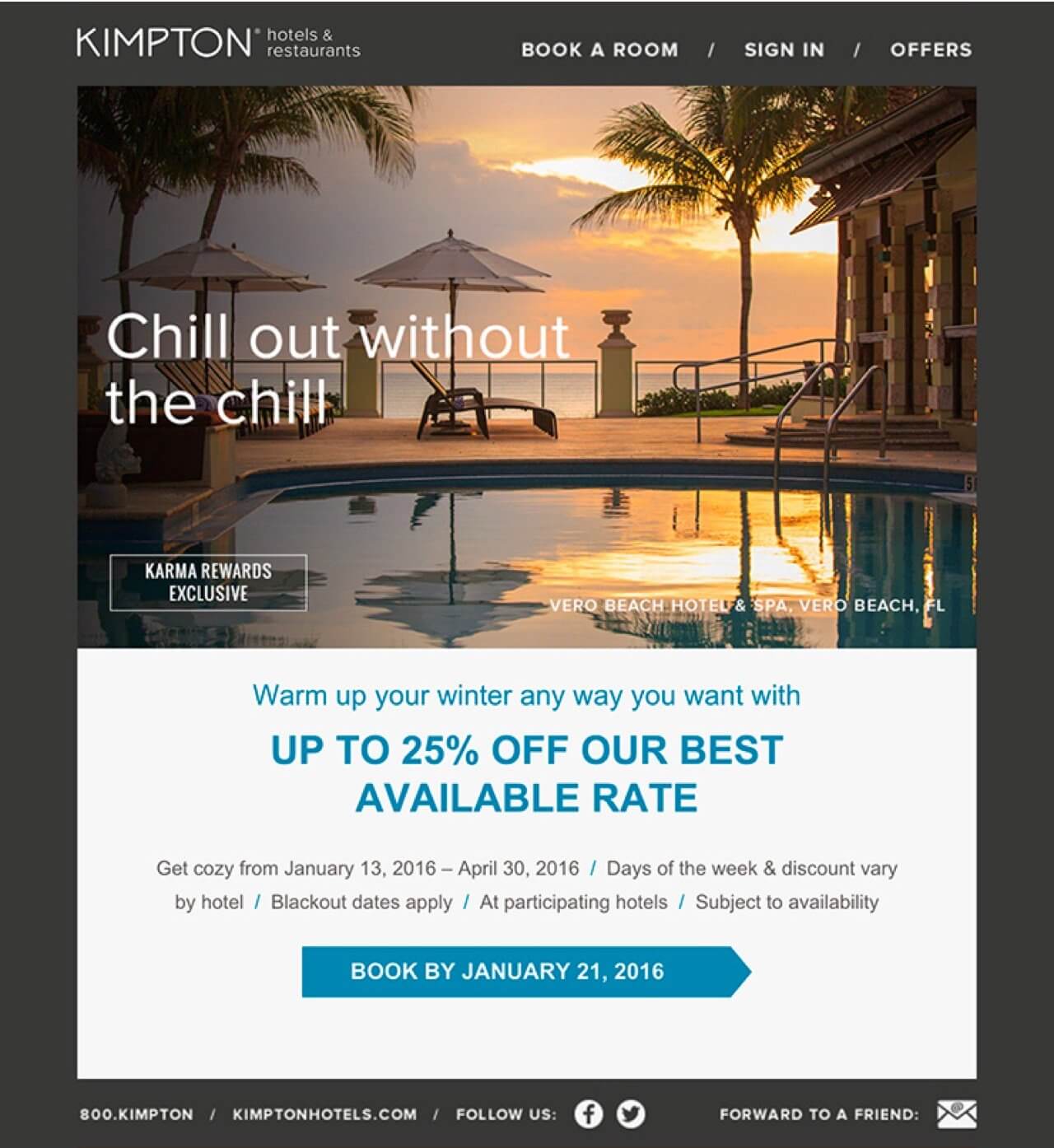
- Craft Compelling Content and Subject Lines: Your email is competing with dozens of others in a busy person’s inbox. To avoid deletion, focus on clear, benefit,driven subject lines that grab attention. For instance, “🏖️ 20% Off Winter Sun Getaways – Exclusive for Past Guests!” is specific and enticing, whereas “Newsletter – January” is bland. In the email content, keep paragraphs short and use imagery to spark interest (a beautiful header image of your pool or a festive photo if promoting a holiday package). Key elements of great hotel emails include:
- Personal greeting: “Dear Sarah,” feels more warm than a generic hello.
- Strong visuals: Photos of your hotel or destination to inspire wanderlust. Many recipients will skim, so pictures can convey a lot quickly.
- Brief body text with clear call,to,action: Explain the offer or message in a concise way. Highlight the value (e.g., “Book 2 nights, get the 3rd free – perfect for a long weekend escape.”). Then have a prominent CTA button like “Book Now” or “View Offer” that links directly to your booking engine or a landing page.
- Mobile,responsive design: A majority of people check email on their phones. Use templates that adjust to mobile screens. Ensure buttons are easily tappable and the text is readable without zooming.
- Include local content or tips: Not every email has to be a sales pitch. Sometimes send valuable content to keep subscribers engaged. For example, a quarterly newsletter that includes “Top 5 Summer Events in [Your City]” or a staff member’s restaurant picks. This positions your hotel as a helpful guide, not just a salesperson. It keeps people opening your emails, so that when a promotional one comes, they’re more receptive.
- Timing and Frequency: How often should hotels email? There’s no one,size,fits,all, but a good rule is consistency without annoyance. Maybe that’s one meaningful update per month, plus occasional special promotions. If you have a lot to share, you can segment to avoid overloading the same people (e.g., send event invites only to locals, or spa promotions only to those who used the spa). Pay attention to seasons – seasonal email campaigns are very effective. For instance, as spring turns to summer, send an email about your summer family package; in November, target snowbirds with a winter getaway deal. Also consider the guest journey: you can set up automated email triggers for key moments. Common examples:
- Pre,Arrival Email: A few days before check,in, send a friendly message with helpful info (weather forecast, check,in details, maybe an upsell like “Would you like to upgrade to a suite at 20% off?”).
- Post,Stay Thank You Email: Thank the guest for staying, invite feedback (perhaps linking to a review site or survey), and subtly encourage future booking (“We’d love to see you again – here’s 10% off your next stay if booked in the next 6 months”).
- Birthday/Anniversary Greetings: If you have date of birth for loyalty members or know a couple’s anniversary (some hotels capture this), send a greeting with a special offer. Even if they don’t immediately book, it shows a personal touch.
- Re,engagement Email: If someone hasn’t opened or booked in a long time, consider a “We miss you” email with a perk to entice them back.
- Use Email to Boost Low Periods: Email marketing is particularly useful to drive bookings during off,peak times. If you know January is slow, plan a campaign in mid,December targeting leisure travelers within a short flight/driving distance, offering a New Year quiet retreat deal. As Amadeus Hospitality notes, if you need to increase occupancy in low season, email is an effective channel to address that – you can quickly push out a promotion to thousands of potential guests at virtually no cost. Unlike ads that incur cost per click, emailing your own list is free aside from your email software subscription, so the ROI on filling even a few otherwise,empty rooms is huge.
- Automation and Drip Campaigns: Modern email platforms allow for automation – take advantage of this to create a drip campaign or nurture sequence. For example, when someone signs up for your newsletter (but hasn’t booked yet), you could set up a sequence .
Automated flows like this nurture prospects over time without you having to manually intervene with each one. Similarly, you can set up a post,stay automation: Day 1 thank you, Day 3 review request, Day 30 “come back soon” with a loyalty offer, etc. Automation ensures consistent communication and frees up your time.
- Monitor Metrics and Optimize: Email marketing is great because you get clear feedback through metrics. Pay attention to open rates, click,through rates (CTR), and conversion rates for your campaigns. If you send 10,000 emails and 20% open (open rate) but only 0.5% click the book now link, that suggests your content or offer isn’t compelling enough for most. You might try A/B testing different subject lines or button wording. According to industry benchmarks, the global average click,through rate for hotel marketing emails is about 4.2%, and the average email booking conversion rate is around 0.8%. So don’t be discouraged if your conversion is around 1% – that can still be profitable. The goal is to keep improving by learning what your audience responds to. If one campaign got a 30% open rate and another only 15%, analyze the subject lines and send times to understand why. If very few people clicked your summer offer, perhaps the offer wasn’t attractive or wasn’t clearly explained – adjust and try again.
- Ensure Compliance and Trust: Always adhere to email marketing regulations (such as CAN,SPAM in the US, GDPR in Europe, CASL in Canada, etc.). This means including an easy opt,out (unsubscribe) link in every email, only emailing people who consented, and being truthful in your subject and sender info. Not only is this the law, but it’s also good for building trust. If a recipient wants to unsubscribe, let them – you don’t want to be the annoying spam in their inbox. Also, maintain list hygiene by occasionally removing or reconfirming inactive subscribers; it improves deliverability and open rates. A clean, engaged list will yield far better results than a large but uninterested one.
- Integration with Other Marketing: Email doesn’t exist in a silo. Mention and link your social media in emails (“Follow us for daily travel inspiration”) to cross,pollinate your channels. Conversely, use social media to capture emails (like promoting a newsletter or a contest that requires sign,up). Also integrate email with your website content – for example, if you publish a new local guide blog post, send it out in an email newsletter. If you run a big campaign (say a summer sale), ensure the messaging is consistent: the email, social posts, and website banners should all reinforce each other. This creates an omnichannel effect where the customer sees a cohesive story wherever they interact with your brand.
In practice, many hotels have seen fantastic results from savvy email campaigns. For instance, one boutique hotel noticed a dip in weekend bookings for the upcoming month. They quickly crafted a “Last,Minute Weekend Getaway – 25% Off” email targeting all past guests within driving distance. The campaign’s open rate was high (the subject “This Weekend: Escape to [Hotel Name] for 25% Off” piqued interest) and a number of recipients took the offer, filling what would have been unsold rooms. The cost of this campaign was essentially zero, but it generated tens of thousands in revenue – that’s the power of email.
Another example: Four Seasons pioneered highly personalized emails leveraging their guest data – if you’ve stayed at one of their hotels, you might notice how their post,stay emails or offers often reflect your past behavior (mentioning the spa if you used it, inviting you to try a sister property similar to one you visited, etc.). This level of personalization contributed to increased repeat bookings, with Four Seasons reporting that such personalized campaigns led to a 15% increase in repeat guests. The takeaway for smaller hotels: even with simpler data (like knowing someone booked a family suite vs a single room), you can tailor messages to be more relevant, and that relevance drives loyalty.
In summary, hotel email marketing campaigns are a direct line to your most interested audience. Treat that privilege with respect: provide value, be genuine, and don’t overdo the sales pitch. A well,timed email that feels personal can delight a guest – for example, receiving a birthday promo code or a note about an upcoming event in their favorite destination might be the nudge that prompts a booking. By building a relationship through email, you stay on a guest’s radar in a friendly way, so that when they’re ready to travel, your hotel is the first place they think of.
Hotel SEO Strategies
“Location, location, location” is a famous mantra in hospitality – and on the internet, your location in search engine results is just as critical. When travelers turn to Google (or Bing or Yahoo) to look for accommodations, you want your hotel to be front and center. This is where hotel SEO strategies come into play. SEO (Search Engine Optimization) is the practice of optimizing your website and online presence so that your hotel appears higher in search engine results for relevant queries (like “hotels in [City]” or “[City] boutique hotel with spa”). Higher ranking means more visibility, more traffic to your site, and ultimately more direct bookings that don’t require paying OTA commissions. Let’s break down key SEO strategies for hotels and actionable steps you can take:
- Optimize Your Website for Search Engines: At a base level, ensure your hotel’s website follows SEO best practices. This includes having relevant keywords in your page titles and descriptions – e.g., your homepage title might be “Luxury Seaside Hotel in Santa Barbara | Hotel California” rather than just “Home”. On your Rooms page, include phrases people search for like “ocean,view suites in Santa Barbara.” Do keyword research to find what terms travelers use. Common targets are “hotels in [City]”, “best [City] hotel”, or specific niches like “[City] pet,friendly hotel” or “[City] family resort.” Incorporate these naturally into your site copy. But avoid “keyword stuffing” (overloading keywords); content should read smoothly for humans first and foremost.
- Local SEO and Google Business Profile: For any local business, especially hotels, Google Business Profile (formerly Google My Business) is a crucial tool. Claim and fully populate your hotel’s profile. This ensures when people search your hotel name or even terms like “hotels near [landmark]”, your listing appears with info like address, phone, reviews, and a link to your website. Make sure your NAP (Name, Address, Phone) information is consistent across all online directories (Google, Bing Places, TripAdvisor, Yelp, etc.). Google’s local ranking considers relevance, distance, and prominence – you can’t change your location, but you can increase relevance and prominence by choosing accurate categories (e.g., “Hotel”, “Resort”), writing a good description, and gathering reviews. Speaking of which, encourage satisfied guests to leave Google reviews, as a strong rating and volume of reviews can boost your local SEO visibility. Many travelers literally type “best hotel in [City]” and trust the Google map pack or review scores that pop up.
- Mobile,Friendly and Fast Website: A huge portion of hotel searches and bookings happen on mobile devices. Google has switched to mobile,first indexing, meaning it primarily evaluates your mobile site for ranking. If your site isn’t mobile,friendly, not only will you frustrate users, but Google may rank you lower. In fact, Google made major updates to favor mobile,friendly pages and could penalize those that aren’t. Ensure your site uses responsive design (adapts to different screen sizes) and test it on phones and tablets. Also optimize for speed: compress images, enable browser caching, and consider using a CDN. Slow load times hurt both user experience (impatient visitors leave) and SEO (Google’s algorithm favors fast sites).
- Quality Content Creation (Content Marketing for SEO): Content is the fuel for SEO. Regularly producing relevant, high,quality content on your site can dramatically improve your search rankings. This goes beyond your static pages (like rooms, amenities, contact). Maintain a blog or articles section where you post local area guides, travel tips, event news, and other informative content. For example, if you write a blog post “10 Free Things to Do in Chicago Near Our Hotel,” you could attract visitors searching for things to do in Chicago, who then discover your hotel. As Prostay’s content marketing guide notes, making your website a go,to destination guide builds your authority and draws in potential guests. Each piece of content can target specific search queries (think of long,tail keywords like “family,friendly activities in [City]” or “where to stay for [Annual Festival]”). By answering travelers’ questions, you not only rank higher but also build trust with readers who may convert to bookers. Remember to subtly incorporate your hotel into the content (e.g., mention how your hotel provides free shuttles to some of the attractions mentioned). Internally link from blog posts to your booking or rooms pages (“After a day exploring, relax at our rooftop pool – check out our special weekend rates here.”). Over time, this content strategy boosts SEO and funnels traffic into bookings.
- On,Page Optimization Checklist: Some specific on,page SEO tips for hotels:
- Meta Tags: Ensure every page has a unique meta title (around 50,60 characters) and meta description (150,160 characters). E.g., Title: “Beachfront Honolulu Hotel & Spa | Royal Palm Resort” – Description: “Royal Palm Resort is a luxury beachfront Honolulu hotel offering ocean,view rooms, spa services, and fine dining. Perfect for romantic getaways or family vacations in Hawaii.” This not only helps search engines understand your page, but also serves as the snippet text that searchers read – so make it compelling and include a call like “Book direct for best rates.”
- Header Tags: Use headings (H1, H2, H3) in your content and include keywords where appropriate. Your homepage H1 might be “Welcome to Royal Palm Resort – A Premier Beachfront Honolulu Hotel.” Secondary headings on the page could highlight key selling points (H2: “Unbeatable Location”, “Luxurious Rooms”, etc. with descriptive text).
- Schema Markup: Implementing Hotel schema structured data on your site can enhance how your listing appears in search results. Schema markup (a bit of code) helps search engines understand your content. For example, marking up your address, star rating, price range, and amenities can sometimes lead to richer search snippets (like showing star ratings or price range directly in Google results). You might need a developer or plug,in for this, but it’s worth the effort for an SEO edge.
- High,Quality Images with Alt Text: Hotels naturally have beautiful images. Make sure image file names and alt text include descriptive keywords (e.g., ocean,suite,balcony,view.jpg with alt text “Oceanfront suite balcony view at Royal Palm Resort Honolulu”). This helps your images appear in image search and also aids SEO/accessibility.
- Freshness: Update your site content periodically. An outdated rates page or last blog post from 2019 can hurt user perception and possibly SEO (Google likes fresh content for certain queries). If you have seasonal info, update it each year, or maintain an active blog with current posts.
- Off,Page SEO and Link Building: A major part of SEO is what happens off your site – namely, other sites linking to yours (backlinks). To search engines, a link from site A to site B is like a vote of confidence for site B’s content. To improve your hotel’s authority in Google’s eyes, you want quality backlinks pointing to your website. How to get them?
- List on High,Authority Travel Sites: Make sure you are listed (with a link) on popular travel or local directories. For instance, if your city’s tourism board has a “Where to Stay” page, see if they’ll include your hotel. Same for local chamber of commerce or hotel association sites.
- Work with Travel Bloggers/Press: If you host a travel blogger or get a review in an online travel magazine, those often come with a link to your site. You might pitch story ideas to media: “Boutique Hotel Offers Unique Cooking Classes” could get a write,up in a lifestyle blog with a link back. These editorial links are gold.
- Leverage Your Content: When you publish great content (like a comprehensive guide or an infographic about your destination), reach out to other websites that might find it useful. Maybe a family travel blog would love to share your “Top 10 Kids Activities in [City]” article (linking to you as the source), or a destination wedding site might link to your post about “Planning a Beach Wedding at a Resort – Checklist”.
- Online Reviews and OTA Listings: Interestingly, the presence of your hotel on OTA sites and review platforms can indirectly aid SEO. While those sites usually link to themselves, having consistent info and lots of reviews on them contributes to your hotel’s overall online prominence. Also, some savvy hotels put their website URL in the description on TripAdvisor or other profiles – even if not a direct hyperlink, it’s out there for travelers to copy,paste.
- Social Signals: While social media links don’t directly boost SEO like a typical backlink (most are “nofollow”), there’s an indirect benefit. If your content gets widely shared, it can lead to more people seeing it and possibly linking from their own blogs/resources. At the very least, active social profiles rank for your hotel name and provide more avenues for discovery.
- Metasearch and SEO Integration: Metasearch engines (like Google Hotel Ads, Trivago, Kayak) aggregate hotel rates and often appear at the top of search results for hotel queries. While participating in metasearch is more of a paid marketing/distribution effort, it complements SEO. If a traveler searches “Hotel in Paris”, they might see a Google map pack or Google’s hotel listings with rates (metasearch) even above organic results. To ensure you capture those clicks, you should list your hotel on these platforms and keep your rates/availability updated (often via a connectivity partner or channel manager). From an SEO perspective, think of metasearch presence as occupying more real estate on the results page. A guest might see your website in the organic results and your official rate in the comparison box. This not only increases the chance of a click, but they may notice your direct price is comparable or better than OTAs, persuading them to book direct. In 2025, search and metasearch supremacy is a strategic focus – hotels are using revamped website content for organic rank and aggressive bidding on Google Hotel Ads/Trivago to funnel customers direct.
- Monitor, Analyze, and Adjust: Use tools like Google Analytics and Google Search Console to track your SEO progress. Analytics will show you how much of your traffic (and bookings) come from organic search, which pages get the most entrances, and what your website conversion rate is. Search Console reveals which keywords you’re ranking for and where you could improve. For instance, you might discover you rank #8 for “pet friendly hotel [City]” – close to top 5 but not quite. That could prompt you to create a new section on your site about your pet,friendly amenities or get a few pet travel blogs to link to you, aiming to bump that ranking higher. Regularly audit your site for SEO issues (broken links, missing tags, slow pages) – there are SEO tools (like SEMrush, Moz, or even free ones) that can help identify problems.
- SEO and User Experience Go Hand,in,Hand: It’s worth noting that what’s good for SEO is often good for the user and vice versa. Google’s algorithm increasingly values user experience signals – like how long someone stays on your site (do they find it useful or leave immediately?), or if they quickly bounce back to search results (indicating they didn’t find what they needed). By providing robust information, easy navigation, and fast performance, you please users which in turn pleases the search engines. For example, having a FAQ on your site that answers “How far is the hotel from the airport?” or “Does the hotel have parking?” not only reduces friction for users but can also capture those long,tail searches directly, and keep visitors on your page longer.

To illustrate the power of SEO: Red Roof Inn ran a clever campaign a few years ago targeting stranded travelers. They noticed how many people search for hotels near airports when flights are canceled. By using flight delay data and optimizing ads/search presence for queries like “hotel near [Airport] tonight”, they achieved a 266% increase in non,branded mobile bookings and huge conversion jumps. While that was more of a PPC strategy, it underscores the principle of aligning your online presence with real,time customer needs. On the pure SEO side, IHG’s boutique brand Kimpton, for example, long focused on content like local city guides on their sites to draw in traffic organically, which helped many of their hotels rank on the first page for searches like “boutique hotel in [City]” without paying per click. The direct bookings gained through those organic placements saved hefty OTA commissions over time.
In summary, hotel SEO strategies are about being visible when and where your potential guests are looking. By investing in your website’s SEO – from technical optimizations to rich local content – you’re investing in a long,term asset that continuously brings in qualified leads (travelers actively searching for what you offer). It’s like having a friendly, knowledgeable salesperson (your website) standing at the gateway of the internet 24/7, ready to greet searchers and show them why your hotel is the perfect choice. With strong SEO, you guide more guests to book directly through you, lowering distribution costs and building a direct relationship that you can nurture through the other marketing channels we’ve discussed.
Hotel Content Marketing Ideas and Strategies
Content is king – you’ve probably heard the saying. In hotel marketing, content marketing is the art of using valuable, relevant content to attract, inform, and engage your target audience (and ultimately drive bookings). Instead of bluntly pushing promotions all the time, content marketing is about storytelling and providing useful information that naturally draws travelers to your brand. For hotels, this can be a game changer: by positioning yourself as not just a place to stay, but a local expert and an experience provider, you differentiate from competitors and give travelers compelling reasons to choose you.
Let’s dive into hotel content marketing ideas and how you can implement them:
- Local Area Guides and Destination Content: One of the richest veins of content for hotels is your destination. Prospective guests aren’t just looking for a hotel – they’re looking to experience your city or region. By creating local area guides, you tap directly into what travelers are interested in. For example:
- Write blog posts or downloadable guides about attractions, dining, and hidden gems near your hotel. A guide titled “48 Hours in [Your City]: An Insider’s Itinerary from the [Your Hotel] Team” could showcase a perfect two,day plan including places to visit, where to eat (with maybe one of those being your own restaurant if you have one), and how to relax in the evening (perhaps at your hotel’s rooftop bar).
- Create neighborhood spotlights: If your city has distinct neighborhoods, do a series where each post covers one area’s character and things to do, with your hotel as the ideal home base for exploring it.
- Seasonal content works wonderfully: “Top 5 Summer Festivals in [City]”, “Best Winter Activities around [Destination]”, etc. Not only does this provide timely value, it also gives you material to share in seasonal email campaigns and social posts.
- Leverage your staff’s knowledge. A fun twist: have your concierge or long,time employees contribute their personal tips (“Concierge John’s Favorite Parisian Breakfast Spots” or “5 Selfie Locations Only Locals Know – from our Front Desk Team”). This not only yields authentic content but also shows the human side of your hotel.
By publishing such guides, you become the go,to resource for travelers. Guests might bookmark your blog even before they decide on a hotel, simply because you offer great advice – and that familiarity means when it’s booking time, you have an edge. Plus, as noted earlier, this greatly helps SEO by targeting informational search queries.
- Behind,the,Scenes and Human Interest Stories: People love to see what goes into creating a great guest experience. Use content to pull back the curtain:
- Staff spotlights: Do a profile on a team member once a month. Example: “Meet Maria, Our Pastry Chef – Creating Sweet Memories at [Hotel]”. Talk about her morning routine baking croissants, her favorite recipe, and maybe a baking tip for readers. This personal touch can be a blog post and cross,posted on social media. It makes guests feel like they know the people waiting to welcome them.
- A Day in the Life: Consider a short video or photo story following a housekeeper’s day prepping rooms to perfection, or a montage of what happens at the hotel from dawn to midnight. It’s fascinating for guests to realize the effort and care in the background.
- Hotel history or design stories: If your hotel has an interesting history or art/architecture, create content around it. Perhaps a blog series “Stories from Our 100,Year,Old Lobby” or a video interview with the interior designer explaining how the décor reflects local culture. This appeals especially to history buffs and design aficionados.
- Showcase values and initiatives: Modern travelers, especially younger ones, care about values. If your hotel practices sustainability or community support, create content about it. For instance, a post titled “Going Green: 5 Eco,Friendly Practices at [Your Hotel]” can detail your solar panels, water conservation, local sourcing of food, etc. Or share about charity events or partnerships with local businesses. This not only informs but also builds an emotional connection with guests who share those values.
- User,Generated Content (UGC) and Guest Stories: As mentioned in the social media section, your guests’ experiences are content gold. Incorporate UGC into your broader content marketing:
- Guest Testimonials & Case Studies: Don’t just collect star ratings; collect stories. For example, interview a couple who got engaged at your hotel and write a piece about how you helped plan the surprise. Or have a family write a short “What our vacation at [Hotel] meant to us” and share their photos. Such testimonials with narrative can be a section on your website (with pictures) or a feature on your blog. They allow prospective guests to see themselves in those stories.
- Highlight Events and Celebrations: If your hotel frequently hosts weddings, corporate retreats, or other events, ask organizers or attendees if you can write about their event (or have them contribute a guest post). “Behind the Scenes of the Smith,Jones Wedding at [Hotel]” could showcase how your team made a dream wedding come true (wonderful promotion for your wedding services). Likewise “5 Tips for a Successful Business Retreat – Lessons from the TechCo Offsite at [Hotel]” demonstrates your capability for corporate events while providing useful tips.
- Social Media Roundups: Periodically do a roundup on your blog like “Our Favorite Guest Instagram Photos This Season”. With permission, repost a selection of the best guest photos of your property or experiences, along with captions and maybe some commentary. It’s a nice way to recycle social content into longer,form content. Plus, it gives a shoutout to those guests, encouraging more people to share their moments.
- Contests and Campaigns: Run content campaigns that involve guests, such as a photo contest (“Share your best [Hotel] memory”). Then showcase the winners or top entries in a blog post or gallery on your website. This not only generates buzz but also yields a batch of heartfelt content.
- Multimedia Content – Videos, Virtual Tours, and More: Content marketing isn’t only text. Explore various formats:
- Video Tours and Experiences: Create virtual walkthroughs of your property – a narrated tour of your presidential suite, or a “walk with us” video from the hotel lobby out to a nearby attraction (showing how close you are). Videos can live on YouTube (which is great for discovery) and be embedded on your site. Shorter clips can be shared on social media. According to trends, adopting a video,first strategy is key in 2025 – including short,form clips for TikTok/Reels and longer,form on YouTube. Videos keep people engaged longer (which helps your site metrics) and can convey atmosphere and scale much better than photos.
- 360° and VR content: Consider having a 360,degree photo or video of your rooms or facilities, which users can explore interactively. Some hotels even provide VR experiences. For instance, a virtual reality “preview” of your resort where users can look around the beach or inside the spa. As immersive tech gets popular, offering virtual tours and AR/VR previews can set you apart. Many travelers appreciate being able to virtually “stand” in the room before booking.
- Interactive Content: Maybe embed a Google Map with pins of your recommended spots around town, or create a quiz like “What kind of traveler are you?” that suggests a package or itinerary at the end. Interactive pieces can be very engaging and share,worthy.
- Infographics: If you have interesting data or tips, infographics can be effective. For example, “Business Traveler’s Checklist” or “How [City] Visitors Spend Their Day (data from our concierge)” – visualizing data or tips can garner shares on Pinterest or travel forums, extending your reach.
- Content Distribution Channels: Creating content is half the battle – you also need to distribute it. We’ve touched on some channels (social media, email). To recap and add:
- Your Website/Blog: This is your content hub. Make sure it’s easy to find your blog or guide section from your main menu. Organize content by category (Destination Tips, Hotel News, Events, etc.) so users can find what interests them.
- Email Newsletters: As discussed, share your new content with your subscribers. It keeps your emails from always being about selling – you’re providing value. For example, send a “Fall Newsletter” that includes a section on a recent blog post about fall activities, a note from your GM about a renovation, and a special offer.
- Social Media: Every piece of content you create can spawn multiple social posts. A blog post can be shared on Facebook and LinkedIn, teased on Twitter, and a nice photo from it put on Instagram with a caption summary and a link in bio. If you have a video, upload to Facebook and YouTube for maximum reach. Tailor the format: e.g., if you have “10 Tips” in a post, maybe create a quick slideshow or carousel for Instagram highlighting 3 of them, then say “read the rest on our blog.”
- Hotel Rooms and On,Property: Don’t forget, your content can also be repurposed offline or on,premise. That detailed neighborhood guide could be distilled into a printed handout or a section in your in,room compendium. Or display a QR code at the front desk that says “Looking for things to do? Check out our insider guides” leading to your blog. This shows even current guests that you have more to offer (which might encourage them to do more activities or extend their stay).
- Storytelling and Brand Voice: The most successful content marketing makes the reader feel something – excitement, trust, curiosity, belonging. Identify what your hotel’s brand voice is and ensure consistency. Are you formal and luxurious, or playful and quirky? If the latter, maybe your content has a fun, humorous tone (like the Hans Brinker campaign which used extreme humor, or the Moxy Hotels brand which is youthful and edgy). If the former, perhaps your content has an elegant, refined voice, focusing on quality and heritage. Consistency builds recognition. Marriott’s “Travel Brilliantly” campaign was essentially content marketing – they launched a whole website of travel stories and invited ideas from travelers, aligning with their innovative brand image. This content wasn’t directly selling Marriott rooms, but it associated the Marriott brand with inspiring travel experiences, subtly nudging consumers toward their hotels.
- Trends in Content Marketing 2025: Stay on the lookout for new content ideas that match current trends. In 2025, some noted trends include video,first content, AI,powered personalization, and sustainability storytelling. For example, video,first means perhaps prioritize creating a vlog series about your location. AI personalization might involve dynamically showing different content to different users (advanced, but e.g., your website could recommend blog articles based on what the user looked at – “Since you viewed our wedding page, you might enjoy our article on Top 5 Romantic Proposal Spots in [City]”). Sustainability storytelling, as mentioned, means highlighting eco,initiatives. If your audience is globally diverse, consider creating content in other languages (even if just key pages or subtitles for videos) – that could open you to new markets.
- Measuring Content Success: You’ll want to measure how your content marketing is performing. Basic metrics include page views and time on page for your articles (indicating if people find them and stick around). Track which content pieces actually lead to conversions – e.g., do people who read your “Things to do” guide often click to the booking page? Use Google Analytics goals or attribution tools to see if content readers eventually book (even if on a later visit). Also, see what content gets shared or commented on – those are signs of resonance. Content marketing can sometimes have a softer, long,term ROI (improving brand perception, SEO, etc.), but over time you should see patterns of certain content driving traffic and bookings. Adjust your strategy accordingly: produce more of what works, refine or retire what doesn’t.
To illustrate, consider a small mountain lodge that started a simple blog with seasonal hiking guides and nature photography tips. At first, they only got a few dozen readers (mostly past guests). But one well,written post, “Hidden Waterfall Trails within 1 Hour of [Town]”, got picked up by an outdoor enthusiast forum and a local news site. That post alone drove thousands of new visitors to their site over a summer – many of whom checked out the lodge and some booked rooms to turn the day hike into a weekend getaway. That content piece kept giving for months, as it ranked in Google for “waterfall trails [Region]”. Inspired, the lodge doubled down on content, partnering with a local hiking guide for expert articles and even producing short YouTube videos of trail highlights. Over a couple of years, the lodge became known as an authority on outdoor adventure in their region – and saw direct bookings climb, partly because a large chunk of their website traffic (and email list) was coming from their content rather than paid ads. This story underscores how authentic, useful content builds trust and visibility, which translates to revenue in a way that feels very organic.
Ultimately, hotel content marketing is about showcasing the experience, not just the room. It’s about painting the picture of the memories guests will make, the problems you solve for them (like having a ready itinerary), and the unique value you offer beyond a bed. By investing in content, you’re nurturing a community of travelers who see your hotel as a helpful friend, not just a faceless business. And when people feel that connection, they’re far more likely to choose your property and become loyal guests for years to come.
Hotel Digital Marketing Trends (2024–2025)
The digital world moves quickly, and savvy hotel owners keep an eye on emerging trends to stay competitive. As we look at 2024 and 2025, several global hotel digital marketing trends are shaping how hotels connect with guests. These trends often stem from broader technological and societal shifts – from the rise of artificial intelligence to changing traveler values. Let’s explore the top trends and how you can leverage them:
1. AI-Powered Personalization
Artificial Intelligence (AI) is no longer sci,fi in hotel marketing; it’s here, and it’s making guest interactions more personalized than ever. AI-powered personalization has become table stakes (a baseline expectation). What does this mean? Essentially using AI and machine learning to analyze data and automate tailored experiences for guests. Concrete examples: , Dynamic Content & Offers: AI can help show the right offer to the right guest at the right time. For instance, your website or email might highlight a spa discount to a guest who frequently books massages, while showing a family package to a guest who traveled with kids before. AI can crunch past booking data and browsing behavior to predict what each user is likely to want. , Chatbots and Virtual Assistants: More hotels are deploying AI chatbots on their websites or Facebook Messenger to handle common inquiries (“Do you have free parking?”) and even facilitate bookings. Modern chatbots, powered by natural language processing, can handle complex questions and converse in multiple languages 24/7. Guests get instant answers and assistance, while hotels reduce the load on staff. These bots can also upsell (“You’re booking 2 nights – can I interest you in a late checkout for $30?”). , Predictive Analytics: AI,driven systems can analyze booking trends and external data (like flight searches or events) to forecast demand and optimize pricing (revenue management). While this is more operations than marketing, it heavily influences marketing spend and focus – e.g., if AI predicts a dip in weekend occupancy next month, it might trigger your marketing team to run a targeted campaign for that period. , Email & CRM Automation: As touched in email section, AI can determine the best time to send a message to each guest, or even write subject line variations. Some hotels use AI to auto,segment guests into clusters based on behavior, then send tailored campaigns. InfluencerMarketingHub noted about 69% of marketers have AI inside their campaigns already, showing how widespread this is becoming. , Personalized On-Property Marketing: Once guests arrive, AI can enhance their experience (which in turn boosts marketing via good reviews and loyalty). Think personalized app notifications: your app greets the guest by name and suggests a happy hour drink because it knows they redeemed a bar coupon last time. Or AI in digital concierge systems recommending local activities based on the weather and the guest’s profile (e.g., it’s raining – suggest the nearby museum they haven’t been to, rather than the park).

Key takeaway: Guests increasingly expect that you know and cater to their preferences. AI makes this scalable. Hotels not using these tools might fall behind as those who do will offer a smoother, more customized guest journey – from browsing to booking to staying – which can significantly improve conversion and guest satisfaction.
2. The Drive for Direct Bookings Intensifies
Hotels are escalating efforts to reclaim bookings from OTAs and pay fewer commissions. In 2025, expect an industry,wide push for direct bookings. Several factors are fueling this trend:
- Member-Only Perks: Many hotels (from big chains to independents) are giving special benefits for booking direct. This can be a lower rate for loyalty members, free Wi,Fi, welcome drinks, or flexible cancellation that OTAs might not offer. Hilton’s aforementioned campaign and IHG, Marriott’s “Member Rates” all drive this message: “Book direct, get something extra.” Guests are learning that often the best deal is on the hotel’s own site, especially after you click through a few OTA price comparisons.
- Metasearch & OTA Bidding War: Hotels are investing in search engine marketing and metasearch advertising to capture customers during the research phase. For example, bidding on Google Hotel Ads so that the hotel’s direct rate appears prominently, sometimes highlighted as “Official site”. They’re also doing smarter SEO (as we covered) to be the top organic result. This trend means if you’re not participating in these channels, you might lose out. On metasearch like Trivago or TripAdvisor meta, if only OTAs show rates for your hotel, you’re ceding potential direct customers. In 2025, more hotels will use tools (sometimes through their booking engine providers or digital marketing agencies) to ensure their rates are listed and competitive on these platforms.
- Conversion Optimization: Getting a traveler onto your website is step one; getting the booking is step two. Hotels are improving their websites and booking engines to increase conversion rates. This includes mobile wallet payments, showing prices in the user’s currency, simplifying forms, and adding urgency or reassurance messages (“Only 2 rooms left at this rate!” or “No booking fees”). Also, incorporating price matching guarantees and even chat support on the booking page to answer last,minute doubts. The trend is to treat the hotel website more like an e,commerce site with sophisticated sales funnels. For instance, one,tap payments and local,currency pricing can significantly reduce friction for international guests.
- Retargeting and Loyalty Loops: Hotels are capitalizing on first,party data (emails, site visitors) to bring people back. If someone searches on your site but leaves, you can retarget them with a Google or Facebook ad offering, say, 5% off if they finish booking on your site. Post,stay, hotels are sending loyalty offers to convert OTA,booked guests into direct bookers next time (“Thanks for staying via Expedia. Next time, book with us and enjoy a free upgrade using code DIRECT.”). Loyalty programs themselves are being marketed heavily as a reason to book direct (collect points, etc.). According to trends, hotels are capturing data at every touchpoint (like Wi,Fi login, as mentioned, to later send targeted offers).

The reason this trend is so important: even a small shift in direct booking share can have a large impact on a hotel’s bottom line. By driving even, say, 10% more bookings direct instead of via a 20% commission OTA, you effectively increase your net revenue per booking significantly. Plus, direct bookers are more likely to be loyal and respond to your marketing since you know them. So, if you haven’t already, 2024,2025 is the time to sharpen your direct booking strategy – audit your website UX, promote your unique direct perks in all marketing, and consider working with digital marketing specialists if needed to improve your search and meta presence.
3. Short-Form Video and Social Influence
We touched on social media earlier, but it’s worth reiterating with the trend lens: short-form video content is dominating. TikTok’s explosive growth has influenced other platforms (Instagram Reels, YouTube Shorts) and changed consumer content preferences. Travelers in 2025 are often discovering destinations and hotels through quick, engaging videos. , Hotels are increasingly creating or commissioning bite,sized videos: a 15,second room tour with energetic music, a day,in,life at the resort, a testimonial clip from a guest, etc. These videos are tailor,made for sharing and virality. Stats show that nearly 40% of video marketers say sub,60,second clips give the best ROI and more than half of brands are publishing short videos actively. Hotels can’t afford to ignore this, as these videos get better reach and engagement than static posts typically. , Additionally, social commerce and influencer collaborations are becoming more direct. As noted, Instagram and TikTok now let users book or shop through links in,app. A trend is hotels partnering with influencers not just for awareness but to actually drive sales in a measurable way. For example, an influencer might have an exclusive promo code or a trackable link for their followers to book a hotel deal. This way, ROI can be calculated and campaigns optimized. , Live streaming is another micro,trend. Some hotels do live virtual tours or Q&A on Facebook/Instagram Live or host live events (like a cooking class streamed from the hotel kitchen). This real,time content can create buzz and foster personal connection with the audience. , User,generated video: Encouraging guests to share their own TikToks or Reels from your property is essentially free marketing. Some hotels have jumped on TikTok challenges or trends, incorporating their brand in a fun way. For instance, a hotel might do a “before and after travel glow,up” trend where a guest shows themselves tired at work vs. rejuvenated by the pool.
Bottom line: Visual storytelling is more important than ever. Hotels riding this trend are investing in content creation that is mobile,friendly, authentic (polished ads are less trusted; candid clips perform better), and highly shareable. As attention spans shorten, the ability to hook someone in the first few seconds of a video can be crucial.
4. Micro-Influencers and Community Engagement
Influencer marketing for hotels is shifting from the era of mega,celebrities to more micro and nano influencers who have smaller but highly engaged communities. The trend recognizes that an influencer with 5,000 passionate followers might actually drive more bookings (per dollar spent) than one with 5 million who posts a generic promo. , Hotels are forming relationships with local influencers or niche influencers. For example, a hotel in a foodie city might partner with several food bloggers/Instagrammers in that city to showcase its restaurant and nearby eateries. Their followers, being foodie travelers, are more likely to visit. Another example: targeting community leaders or interest group influencers. If your hotel is perfect for hiking enthusiasts (say it’s in the mountains), find hiking YouTubers or Instagrammers. Their audience will value their recommendation of a place to stay for the next trip. And because the influencer’s content is very relevant to the audience, the conversion potential is high. , The approach to working with these influencers is also evolving. It’s more collaborative and long,term. Instead of one,off posts, hotels might create an “Influencer Residency” program – inviting an influencer to stay and create multiple pieces of content or even take over the hotel’s social media for a day. Cayuga Hospitality reports that many campaigns now prefer authentic storytelling over flashy sponsorships – so letting influencers have creative freedom (with some guidelines) often yields content that resonates more naturally with their followers. Community engagement is not just through influencers; it’s also direct. This includes being active in travel communities online (like Tripadvisor forums, Reddit travel threads, etc.) where potential guests ask for recommendations. Some hotels or their marketing reps discreetly participate by giving helpful advice (without overly plugging their hotel, which can backfire). The aim is to be seen as part of the traveler community rather than just an advertiser.

5. First-Party Data and Privacy
With the phasing out of third,party cookies and stricter privacy regulations worldwide, hotels are shifting to a first,party data strategy for marketing. First,party data is information you collect directly from your customers (with consent) – like emails, website behavior, past purchase history. This trend is a response to things like:
- Cookie crackdown: Browsers (Safari, Firefox, and soon Chrome) block many third,party cookies that advertisers used for tracking and retargeting. This means it’s harder to follow users around the web with ads as was common before. Google delaying the deprecation of third,party cookies to 2024 (from earlier 2023) gave advertisers time, but the writing is on the wall: future marketing will rely less on invasive tracking and more on consented, direct data.
- Privacy Regulations (GDPR, CCPA, etc.): Hotels worldwide have had to adapt to laws that require transparency and user control over data. GDPR, for example, means you must have a lawful basis to email someone in Europe (usually explicit consent) and to track cookies (hence all those pop,up consent banners). Non,compliance is costly. So, building a good first,party database (e.g., a robust email list of opted,in guests) is not just smart marketing, it’s compliance,friendly.
- The trend here is hotels investing in CRM systems and data management platforms to unify guest data and use it wisely. Instead of relying on, say, a third,party to target “people who visited travel sites”, you rely on your own list of “people who subscribed to my newsletter” or “past guests who liked spa services” – and then use channels like email, SMS, or even uploading those segments to Facebook as custom audiences for ads.
- Contextual and Content Marketing Rise: Since hyper,targeted ads become trickier without third,party data, some marketers are going back to contextual advertising (placing ads on relevant content sites) and focusing more on content marketing/SEO where you attract the customer organically without needing to track them around. We’ve covered content marketing – its renewed importance is partly because you can’t rely as much on tracking,based advertising in the future.
- Transparency as a Brand Value: Hotels are also using privacy as a selling point. Telling guests “we respect your data” and actually meaning it can build trust. For example, not over,emailing, and being clear about what you do with their info. Some hotels highlight their adherence to privacy as part of the brand’s integrity. , Preparing for AI Assistants: A forward,looking aspect mentioned in the AltexSoft piece is the rise of AI booking agents. If consumers start using virtual assistants (“book me a hotel in London under $200 with free breakfast”), the game changes. In that scenario, hotels will want to ensure their data (like rates, amenities) is easily accessible to AI and that they have some direct channel to those AI systems (maybe via integrations). It’s speculative but hotels that invest in open data (e.g., via Google’s free booking links or voice,search optimization) could have an edge.

6. Immersive and Experiential Marketing (AR/VR, 360° Content)
As technology advances, hotels are adopting immersive content to entice potential guests. Virtual Reality (VR) tours and Augmented Reality (AR) experiences are becoming more common, especially for upscale or innovative brands: , We discussed offering virtual tours as content. The trend extends to doing something imaginative, like Marriott’s Moxy Hotels creating an AR game world “Moxy Universe, Play Beyond” for guests. That campaign saw huge engagement (100 million impressions, etc.), showing that mixing play with marketing can pay off in terms of brand buzz. Now, not every hotel will build a full AR game, but smaller,scale AR might be used – e.g., point your phone at a hotel mural and a AR animation plays explaining the art’s story. , VR being used in sales: For instance, a hotel salesperson might send a VR headset or link to a meeting planner so they can “virtually walk through” the banquet hall set,up without visiting in person. Some travel fairs now allow VR hotel tours at booths. , 360° images on Google and social: Google Street View (now part of Google Maps) allows hotels to upload 360 images of interiors. Many hotels are doing that, so that in Google results, users can jump into a panoramic view of the lobby or a room. On Facebook, you can post 360 photos that users can pan around – a cool way to show a beach view.

These immersive elements serve one goal: reduce the uncertainty a traveler has about “what it’s really like” at your hotel, thereby increasing their confidence to book. As AR/VR tech becomes cheaper and more widespread (with AR capable on any smartphone and VR headsets more common at home), this trend will likely grow. It’s also a chance for creative marketing – something like a hotel,themed mini VR game or a filter on Instagram (maybe a filter that places your hotel’s scenery behind the user’s selfie) can both promote and entertain.
7. Sustainability and Social Responsibility Marketing
Travelers, especially Gen Z and Millennials, are increasingly drawn to brands that align with their values. A big trend is sustainability storytelling – no longer a niche, it’s mainstream. In 2025, hotels are highlighting their eco,friendly efforts not as a footnote, but as a core message. However, authenticity is crucial; it can’t be greenwashing (saying you’re green without real action). , Many hotel brands have launched initiatives (Hilton’s “Travel with Purpose”, Hyatt’s “World of Care”, Marriott’s “Serve 360”, etc.) and they share progress updates in marketing. Even small hotels can do this: sharing that you’ve eliminated single,use plastics, or started a local community project, can inspire guests. Kimpton’s survey found 85% of people want travel brands to show diversity and realness, and 76% prefer realistic over idealized content – that applies to social issues, including sustainability. So showing genuine practices (e.g., behind the scenes of your kitchen garden or your team volunteering) resonates. , Some hotels incorporate sustainability into the guest experience (and thus marketing), like offering a free extra night if you travel there by train instead of flying (encouraging lower carbon footprint travel). These kind of bold initiatives tend to get media coverage too. , Health & Wellness could be tied in, as part of the “responsible travel” trend post,pandemic.

Hotels marketing themselves as safe, clean, and health,conscious (with perhaps on,site COVID,safe amenities or wellness packages) was a short,term trend during the pandemic, but long,term it’s blending into this overall theme of caring for guests and planet alike. , Social responsibility beyond green: diversity, inclusion, supporting local culture. For example, a resort might market that it supports indigenous communities by hiring local staff and offering cultural workshops to guests – giving travelers a richer experience and a sense their money is going to a good cause. Just as Kimpton’s “Stay Human” campaign emphasized inclusivity and was extremely well,received, other hotels are following suit to showcase their human side.
8. “Bleisure” and New Segment Targeting
The blending of business and leisure (“bleisure”) travel has been talked about for years, but it’s been supercharged by remote work trends. Many professionals can now work from anywhere, at least part,time, which leads to longer stays or mixing work with vacation. Hotels are marketing to these hybrid travelers: , Packages or promos that encourage weekday stays (e.g., “Stay 4 nights (Mon–Thurs) and get free co,working space and coffee all day” targeting remote workers). , Highlighting amenities like fast Wi,Fi, comfortable work desks, and quiet zones in marketing materials, even if you’re a resort.

Conversely, for business hotels, mentioning nearby attractions or offering weekend tourist packages can entice business travelers to extend into leisure. , Targeting new customer segments via digital ads is easier than ever. For instance, using LinkedIn or Facebook to specifically target remote workers or digital nomads with messaging like “Tired of your home office? Work by the beach for a week at [Hotel] – special long,stay rates.” Some hotels have created “workation” packages explicitly. , Also, the pandemic blurred lines of segments: families might travel mid,week, business travel is returning but with a twist, etc. Hotels that adjust their marketing personas (maybe working with niche travel agencies or communities, like “Women who solo travel” or “Pet owners road tripping”) can tap into loyal sub,communities.
9. Multi-Channel and Omnichannel Marketing
As the number of touchpoints grows (from social to voice assistants to messaging apps), hotels are embracing an omnichannel approach – ensuring a presence and consistent message across platforms. A guest might discover you on Instagram, visit your website, chat via WhatsApp to ask a question, and finally book after seeing a retargeting ad on Google. If these experiences feel seamless and cohesive, you’ve done it right. , One trend is using messaging apps for marketing.

Many hotels now use WhatsApp or WeChat (important for Chinese market) not only for guest service but occasionally for promotions (with opt,in). For example, sending a broadcast message about a last,minute deal to all contacts who have opted for WhatsApp updates. , Email + Social + Paid integration: Marketing teams are using insights from one channel to inform another. If certain blog content performs well (lots of views), they might turn that into a YouTube video or pitch to media. If email data shows many guests are interested in spa, they’ll run spa,centric social ads. , The notion is to create a unified journey. A practical tip: maintain a consistent tone and branding whether someone reads your tweet or your brochure or your chatbot greeting. Also, track the customer journey – there are tools to see that a user clicked an ad, then signed up for email, then booked; knowing these paths helps allocate budget to the most influential channels.
10. Conversion Modeling and Attribution
This is a bit technical, but worth noting for marketing strategy: with privacy changes, it’s harder to directly track every booking’s source. In response, companies like Google rolled out conversion modeling, using AI to fill gaps where direct tracking is missing. As a hotel marketer, you’ll lean more on aggregate data and modeled insights rather than exact referral counts. The trend is toward trusting broader patterns (and combining data sources like website analytics, CRM bookings, etc.) to gauge what works. , Attribution tools: Hotels are investing in analytics that can attribute revenue to marketing channels more intelligently, including view,through conversions (someone saw an ad but didn’t click, yet later visited the site and booked). These help justify spend on upper,funnel campaigns like video ads or social content which might not get last,click credit but do influence people.

In essence, the future outlook is that hotel marketing will be more data,driven and personalized, yet also more privacy,conscious and authentic. It’s a balancing act: use advanced tech like AI to tailor experiences, but also engage with consumers on a human level about things they care about (values, stories, community). The hotels that thrive will likely be those that adapt quickly to these trends – adopting new technologies when they provide an edge, and pivoting strategies as traveler behavior evolves.
For example, a hotel that in 2015 was spending mostly on billboard ads might find in 2025 that its best ROI comes from a combination of Instagram video campaigns, a well,optimized website, and an email,based loyalty nurture program – none of which were traditional “advertising” a decade earlier. Keeping an eye on trends ensures you’re allocating your precious marketing budget and time where it counts.
To conclude this trends section, imagine the hotel marketing landscape as an ever,shifting map. Right now, the markers on that map point to hyper,personalization, direct booking focus, engaging short content, authentic voices, and tech,enabled convenience as the routes to travelers’ hearts. By staying updated and willing to experiment, hotel owners can navigate these changes and even lead the way, turning trends into opportunities to capture more guests.
Case Studies: Successful Hotel Marketing Campaigns
Nothing illustrates the impact of smart marketing better than real,life examples. Let’s look at a few successful hotel marketing campaigns from various brands – each employing different strategies – and draw lessons that you, as a hotel owner, can apply to your own marketing efforts.
Hilton – “Stop Clicking Around” (Direct Booking Campaign)
What it was: Hilton’s global campaign launched in 2016 to promote direct bookings. The message was simple and bold: stop wasting time searching all over (on OTAs or elsewhere), because Hilton guarantees the best price on its own site for Hilton Honors members, plus you get extra perks (free Wi,Fi, etc.). They advertised this via TV commercials, online ads, social media, email blasts, and even offline events, featuring slogans and even popular music (The Rolling Stones in ads).
Results: It became Hilton’s largest,ever marketing campaign and was hugely effective. Hilton reported that their direct web bookings reached record levels and grew much faster than OTA bookings after the campaign. In one quarter, direct web bookings’ share was growing 5x faster than OTA share for Hilton. Their mobile app usage also soared (150% increase in app bookings year,over,year) as the campaign pushed their app as well. Essentially, Hilton not only gained more direct bookings (saving on commissions) but also boosted their loyalty program sign,ups tremendously as membership was required to get the perks.
Why it worked: Hilton addressed a clear pain point for travelers – the tedious price hunt – and offered a compelling solution: trust us, you won’t find a lower price elsewhere, and we’ll even give you extra goodies. The campaign was everywhere (omnichannel reach) and had a consistent, easy,to,remember message. It also tapped into star power (using well,known music and broad media coverage) to grab attention. For hotel owners, the lesson is to focus on a strong value proposition for direct booking and shout it from the rooftops. Even if you don’t have Hilton’s budget, you can emphasize in your own channels “Book direct = best rate + [X benefit]” and make that a core part of your marketing narrative. Another lesson: Hilton personalized perks to what modern guests want (Wi,Fi, digital key, etc.). Think about what perks you can realistically afford that matter to your guests, and highlight those.
Cautionary note: Hilton’s success also came from careful execution. Marriott tried a similar direct campaign (“It Pays to Book Direct”) and faced a hiccup when an ad seemingly insulted travel agents, causing backlash. They had to pull that part. So, when crafting your message, be bold but avoid disparaging partners or anyone else – focus on your positives.
Red Roof Inn – “Turning Flight Cancellations into Hotel Stays” (Real,Time Marketing)
What it was: A creative digital campaign by Red Roof Inn (a U.S. economy hotel chain) in 2014. They noticed an opportunity: thousands of passengers get stranded each day due to flight cancellations, often needing an immediate nearby hotel. Red Roof Inn built a system to monitor flight cancellation data in real time, and whenever major cancellations at certain airports spiked, it automatically triggered search engine ads like “Stranded at [Airport]? Find a room at Red Roof Inn” targeted to the location. Essentially, they reached travelers at the exact moment of need via mobile search.
Results: The campaign was highly successful for a modest budget. Red Roof Inn saw a 266% increase in mobile bookings for the targeted searches, a huge leap in conversion rate (375% jump) and doubled click,through rates on their ads. It also earned them a lot of praise and media coverage in marketing circles for ingenuity.
Why it worked: This is a great example of data,driven, context,based marketing. Red Roof Inn understood their customer’s pain point (flight canceled, need a room now) and used technology to address it at just the right time. It’s about being useful, not just promotional. The lesson for other hotels is to think creatively about demand triggers. Maybe for your hotel it’s something like: when a big event (concert, sports, conference) in town ends late, run ads that night for “Too tired to drive home? Stay tonight at [Hotel] – special last,minute rate!” Or if bad weather is coming and you have a cozy hotel, target “Snowstorm special – stay warm with us instead of risking a drive.” These require some setup and real,time action, but the principle is matching marketing to immediate customer needs.
Key takeaways: Be agile and seize unique opportunities. Also, hyper,local targeting can yield great ROI because you’re not wasting impressions on people who don’t need you. Red Roof Inn only targeted specific airports and times, which made the ads extremely relevant. In digital marketing, relevance is king.
Starwood – Influencer Campaign for New Hotels
What it was: Starwood Hotels (before merging with Marriott) wanted to promote two new boutique hotels in Paris (Tribute Portfolio brand). They invited five popular travel Instagram influencers for complimentary stays and encouraged them to post their experiences – chic hotel interiors, local Parisian adventures, etc., tagging the hotel and Starwood. They also partnered with LiketoKnow.it (an Instagram shopping tool) so that users who “liked” the influencer posts got an email with a direct booking link, making it easy to book the hotel from the post.
Results: The campaign significantly boosted Starwood’s social media presence. Their main Instagram gained over 500,000 followers, partly thanks to the exposure from influencers’ fans. The specific new hotels saw increased website visits and inquiries, particularly from the home countries of those influencers, indicating real interest was generated. While exact booking numbers weren’t publicly disclosed, Starwood considered it a success in terms of buzz and brand building.
Why it worked: Starwood leveraged trusted voices (influencers) to tell an authentic story about the hotels. The influencers’ content was aspirational yet personal, far more relatable than an official ad. It reached an audience that Starwood might not have accessed easily on its own. And importantly, Starwood made the journey from inspiration to booking frictionless by using the tool that allowed booking info to be sent to users immediately. That’s a key lesson: if you use influencers to inspire, be ready to capture the demand right away (have a link in bio, a swipe,up, a code, etc.).
For hotel owners, this shows that even without Starwood’s scale, you could invite a local or niche influencer for a stay in exchange for posts. The cost (a free stay, maybe some meals) can be minimal compared to buying ads, yet the content created can have lasting marketing value (you can reshare it, etc.). The caution is to pick influencers carefully – their style and audience should match your target. You want genuine enthusiasm, not a forced promo, otherwise followers will see through it. Also, manage expectations and agreements clearly: what will they get, what will they provide.
Moxy Hotels – “Moxy Universe, Play Beyond” (Experiential/AR Campaign)
What it was: Moxy, Marriott’s trendy hotel brand, launched an augmented reality experience across their Asia,Pacific hotels. Guests could use their phones to enter a “Moxy Universe” – create avatars, play AR games, and interact with virtual elements overlaid on the real hotel environment. For example, you could see holographic avatars at the bar or a virtual workout buddy in the gym via your phone. It was a marketing campaign to reinforce Moxy’s playful, youthful image and to get people talking about the cool, techy experience.
Results: It generated huge buzz. The campaign racked up 100 million+ brand impressions, TikTok and WeChat mentions spiked by 200%+ as people shared their AR experiences, and nearly 900,000 interactions were recorded in the AR app. Essentially, it created a viral effect among the target demographic (young travelers in Asia,Pacific) and solidified Moxy as a fun, cutting,edge brand.
Why it worked: Moxy knew its audience (young, game,loving, social media savvy) and gave them what they’d enjoy. The AR game wasn’t just a gimmick; it aligned perfectly with Moxy’s brand of blending digital fun with real,world hospitality. It also encouraged user,generated content (guests naturally shared screenshots and videos of their AR antics). The lesson here is not that every hotel should do AR, but to think about experiences you can create that are unique, shareable, and on,brand. For a rustic lodge, that might be a nature scavenger hunt or stargazing event; for a wellness resort, maybe a meditation challenge with an app. Give guests something out of the ordinary and they’ll do the marketing for you by telling others.
Also, Moxy’s campaign underlines the importance of staying on top of tech trends. They capitalized on interest in AR/VR. A few years ago, some hotels did something similar with Pokémon Go (placing lures to attract players to the hotel) – those who jumped on the trend got free publicity. So, be alert to popular apps/games that could tie into your hotel creatively.
Hans Brinker Hostel – “Worst Hotel in the World” (Honest Marketing)
We discussed this in the social media section, but it’s worth highlighting as a case study too because it’s so bold.
What it was: Hans Brinker Hostel in Amsterdam ran a long,standing tongue,in,cheek campaign branding itself as “The Worst Hotel in the World.” Their ads and posters humorously highlighted terrible features (like “Now with even more noise!” or “Now a door in every room!” implying it used to be worse). They basically admitted to lousy conditions in a way that made young, backpacker travelers laugh and strangely, want to experience it. It turned the hostel’s lack of luxury into a memorable brand identity.
Results: The campaign became famous worldwide in marketing textbooks as an example of radical honesty. It got the hostel tons of publicity and attracted exactly the type of guests who appreciate that humor (often students and backpackers looking for a cheap, fun stay). Hans Brinker achieved high occupancy and carved a unique niche – many travelers go there because of the reputation. They essentially turned a potential weakness (lack of comfort) into a defining feature that sets them apart.
Why it worked: Absolute authenticity and knowing the target audience. Instead of pretending to be something it’s not, Hans Brinker doubled down on being crappy in a fun way. This resonated with budget travelers who wear it as a badge of honor that they survived “the worst hotel.” It also built tremendous buzz because it was so contrary to usual marketing. For other hotels, the direct approach of “we’re bad” likely isn’t suitable – Hans Brinker is an outlier. But the concept of leaning into your unique character is key. If you’re a quirky budget motel on Route 66, you might not claim worst, but you can embrace being kitschy or old,school. If you’re ultra,luxury, maybe your tone is unabashedly opulent. The worst thing is to be generic. Hans Brinker shows the power of a strong, if unconventional, identity. And humor – when appropriate – can be a brilliant marketing tool because it humanizes your brand and engages people (just be careful with humor; it has to land well with your intended audience and not offend).
Kimpton – “Stay Human” (Values,Driven Campaign)
What it was: Kimpton Hotels (a boutique brand under IHG) launched “Stay Human” as a social media and content campaign focusing on real, human stories and diversity in travel. They realized from a survey that most travelers felt that travel marketing was too polished and didn’t represent them – 85% wanted to see a wider range of travelers and creators, and 76% wanted more realistic, unfiltered depictions. In response, Kimpton pledged to feature more diverse, inclusive content. They formed a “Stay Human Creator Collective” of diverse influencers and guests to share genuine travel moments – from a variety of ages, backgrounds, body types, etc.[17]. The content ranged from heartfelt blog posts to Instagram takeovers, highlighting things like kindness among travelers, inclusive events at hotels, and authentic local experiences.
Results: The campaign struck a chord with audiences looking for representation. It garnered billions of media impressions (partly thanks to press coverage on the initiative) and lots of engagement on social media. Many travelers and loyal Kimpton guests voiced appreciation for the relatability. It also boosted brand loyalty – people felt Kimpton “gets it” and stands for something more than just selling rooms.
Why it worked: Kimpton tapped into a cultural shift – travelers value inclusivity and want to see people like themselves in marketing, not just airbrushed models. By taking a stand and reflecting real travelers, Kimpton built emotional connections. The content felt less like advertising and more like a community[17]. Additionally, the pledge and follow,through on showing diversity earned trust (but they had to be genuine; any sign of inauthenticity could’ve been called out).
For other hotels, the lesson is to align your marketing with your guests’ values and be authentic about it. Maybe your guests care deeply about environmental issues – then highlight your sustainability and show it in action. Or maybe your niche is family travel – then feature real families of all shapes and sizes having a blast at your place, not just stock photos.
Also, Kimpton’s campaign was multi,faceted (social, PR, on,property experiences) which magnified its impact. They even made operational changes (like examining how they can be more inclusive on,property, not just in ads). If you embark on a values,driven campaign, it has to reflect reality (for example, promoting diversity means also training staff in inclusive hospitality, etc.).
Takeaway: Modern consumers, especially younger ones, often choose brands that align with their personal values. A genuine campaign that communicates “we stand for X” can differentiate you and build loyalty, as long as you walk the talk.
These case studies span a spectrum: from big,budget multi,channel efforts to clever low,cost tactics. But common threads emerge: , Clear Goal and Message: Each campaign had a specific goal (increase direct bookings, fill rooms during flight cancellations, launch new hotels, build brand identity, etc.) and a clear, simple message or idea driving it. , Understanding the Audience: They all deeply considered what their target guests care about or need – whether it’s convenience, authenticity, fun, value, or values – and crafted campaigns to tap into that. , Bold Creativity: The standout campaigns weren’t timid. They tried something a bit daring or novel in the hotel space – be it cheeky honesty, tech integration, or strongly value,driven content. In a crowded market, a memorable idea goes a long way. , Integrated Execution: Even if using one primary channel, these campaigns often connected multiple touchpoints. For instance, Hilton combined TV, digital, and loyalty program changes; Red Roof used data+search; Kimpton combined social content with PR and internal commitments. Integration ensures guests get a cohesive story and encounter it in various places, reinforcing the impact.
As a hotel owner, you might be thinking, “These are big companies; can I really do something like that?” You might not have their budgets, but you can emulate their strategic thinking on a scale that fits your property. Maybe you can’t run national TV ads like Hilton, but you can redesign your website banner and OTA descriptions to boldly tout your direct booking perks and send emails to past guests with a similar message. You might not build an AR app like Moxy, but you could host a unique event or themed experience that gets locals and social media talking (maybe partner with a local artist for an interactive art night at your hotel).
The key is to be deliberate: identify what you want to achieve, come up with a creative concept to achieve it, ensure it resonates with your guests, and then execute it consistently through the channels you have. And always measure the results. If it works, do more of it; if not, learn and pivot.
Tools and Platforms for Hotel Marketing
To implement the strategies and campaigns we’ve discussed, you’ll likely need some digital tools and platforms to help along the way. As a hotel owner, you may not be personally setting up email automation or analyzing SEO keywords, but knowing what tools are available (and empowering your marketing team or agency to use them) is important. The right tools can save time, provide valuable insights, and amplify your marketing efforts. Below, we’ll cover key categories of hotel marketing tools, what they do, and examples of popular platforms in each category.
| Tool Category | Purpose & Benefits | Examples of Tools |
| Customer Relationship Management (CRM) | Centralize guest data, track interactions and stays, segment guests, and personalize communication. A good CRM is the backbone for understanding your customer’s journey and preferences. It can integrate with your PMS to pull reservation history, and with marketing channels to push targeted offers. CRM helps deliver tailored experiences (e.g., noting that a guest likes red wine and surprising them next visit) and ensures no guest inquiry falls through cracks. | Revinate, Salesforce Hospitality Cloud, Cendyn (Guestfolio) – These store profiles with guest preferences, automate emails, and track ROI of campaigns. |
| Email Marketing Platforms | Design, send, and track email campaigns. These tools provide templates and drag,and,drop editors to create professional emails (newsletters, promotions, etc.) without needing to code. They also handle list management (subscribe/unsubscribe) and crucial analytics like open rates, click,through rates, and conversions. Many allow segmentation – sending to specific groups – and automation like drip sequences. Using such platforms ensures your emails look good (on desktop and mobile) and that you stay compliant with spam laws (they include unsubscribe links, etc.). | Mailchimp, Constant Contact, HubSpot – Mailchimp is user,friendly for newsletters and basic automation. HubSpot offers more advanced CRM,integrated email marketing. All provide performance stats to refine your approach. |
| Social Media Management | Schedule and manage posts across multiple social networks in one place. Rather than posting manually to Facebook, Instagram, Twitter, etc. daily, these tools let you plan a content calendar, schedule posts in advance (great for ensuring consistent activity), and then monitor engagement from a single dashboard. They often provide analytics on engagement rates, follower growth, best times to post, and social listening (mentions of your hotel). This helps maintain an active presence without constant manual effort. | Hootsuite, Sprout Social, Buffer – Hootsuite is popular for managing multiple accounts and provides team collaboration features. Sprout Social offers in,depth analytics and social listening. These tools can save you time and ensure you don’t forget that Tuesday tweet or miss a comment that needs a reply. |
| Content Creation & Organization | Tools to help create visual content and organize your content calendar. Visuals are key in marketing, and not every hotel has a graphic designer on staff. Tools like Canva allow anyone to design attractive graphics (social media images, infographics, posters) using templates. For organizing content, a content calendar (could be as simple as a shared Google Calendar or as advanced as Trello/Asana boards) helps keep track of what’s being produced and when it’s going out. There are also specialized content planners like Metricool for social content planning. | Canva (design), Adobe Spark, Metricool (content calendar) – Canva is extremely popular for creating social media posts, flyers, etc., with hotel,specific templates available. Metricool can plan and auto,publish content and even suggest optimal times. These empower you to produce professional,looking marketing materials in,house. |
| Writing and SEO Tools | For written content (blogs, web copy) and SEO optimization, these tools improve quality and discoverability. Writing assistants like Grammarly or Hemingway ensure your text is clear, grammatically correct, and on brand tone. They’re great for non,native writers or simply catching mistakes. SEO tools help with keyword research (identifying what travelers search for), track your search rankings, and optimize your site content. Some tools also analyze competitors. They effectively guide you on how to tweak your website or content to rank higher (like suggesting “add keyword X to your title” or “get more backlinks”). | Grammarly, Hemingway Editor, Yoast SEO (for websites), SEMrush, Moz, Google Keyword Planner – Grammarly (often used as a browser plugin or in MS Word) catches errors and suggests improvements in real time. Yoast is a plugin for WordPress sites that gives an SEO checklist for each page. SEMrush/Moz are professional SEO suites to find keywords and track performance. Google’s Keyword Planner (free in Google Ads) is great to gauge search volumes for terms like “hotels in [City]”. Using these ensures your content is polished and optimized for search engines. |
| Analytics and Tracking | Tools to measure how your marketing is doing and understand user behavior. The king here is Google Analytics – it tells you how many people visit your site, how they found it (organic search, referral, ad, etc.), what pages they looked at, and if they completed goals (like clicking “Book Now”). You can see, for instance, if a campaign email brought 100 people and 5 of them booked – invaluable for ROI calculations. There are also specialized analytics: social media platforms have their own insights (Facebook Insights, Instagram Insights), email platforms have campaign reports, etc. Hotel,specific tools or your booking engine might have dashboards to show direct booking stats vs OTAs. Tracking tools can also include pixels or tags you place on your site to enable retargeting ads or conversion tracking in ad platforms. Conversion modeling by Google (built into Google Ads) is something that will estimate conversions lost due to privacy changes – but that’s more behind,the,scenes. | Google Analytics, Google Search Console, Facebook Business Suite (for social analytics) – Google Analytics is a must,use to monitor web traffic and marketing effectiveness. The newer GA4 (Google Analytics 4) even tracks across devices and has better privacy features. Search Console shows what queries you appear for and alerts on site issues. Facebook/Instagram’s Business Suite provides metrics on your posts and ads. For a holistic view, you might aggregate data into a dashboard tool like Microsoft Power BI or Google Data Studio to see everything (web, social, bookings) in one place. Remember the saying: “What gets measured gets managed” – these tools ensure you’re not flying blind. |
| Advertising and Metasearch Platforms | These are platforms rather than “tools”, but important to mention as part of your toolkit if you invest in paid marketing. Google Ads allows search ads (bidding on keywords), display ads, YouTube video ads, and also Google Hotel Ads integration for rate listings. Facebook Ads Manager covers Facebook and Instagram ads with detailed targeting. If you work with metasearch (Trivago, TripAdvisor, etc.), their platforms or your partner’s dashboard is your tool to manage bids and budgets. Using these requires some know,how, but they offer powerful levers to drive traffic quickly. The key is linking them with your analytics so you can measure bookings resulting. | Google Ads, Facebook Ads Manager, TripAdvisor/Trivago/OTA Insight (for meta) – Google Ads also includes tools like Google Trends (to see what travel topics are rising). Facebook Ads Manager provides audience creation (you can even target “engaged travelers” persona). There are also channel managers and advertising management services specifically for hotels (like WIWT which is mentioned in HospitalityNet source, or Adara for travel audience targeting). If you’re new to these, start small, perhaps boosting a Facebook post or running a simple Google search ad for your hotel name to make sure direct gets top placement. Over time, these platforms can be scaled for bigger campaigns. |
| Automation and Productivity | These tools streamline repetitive tasks and ensure nothing falls through the cracks. For instance, Zapier is a tool that can connect different apps – e.g., if someone fills a Google Form (maybe a brochure request), Zapier could automatically add their email to Mailchimp and notify you on Slack. Automation can also handle simple workflows like sending a personalized thank you SMS via Twilio to guests when they book (triggered from your reservation system if integrated). Additionally, task management tools like Trello or Asana help your team collaborate on marketing projects (like redesigning the website or launching a campaign) with to,do lists and deadlines. | Zapier, IFTTT, Trello, Asana, Slack (for communication) – Zapier is user,friendly and supports thousands of apps; e.g., you could auto,post your blog updates to Facebook via Zapier. IFTTT (If This Then That) similarly automates but is more template,driven, handy for social cross,posting. Trello/Asana keep your marketing calendar and tasks organized (like content pipeline, campaign schedules). Using automation can save you time and reduce human error (e.g., forgetting to follow up with that travel influencer – set a task reminder!). |
| Hotel,Specific Marketing Solutions | There are software suites made specifically for hotel marketing needs. These often bundle multiple functions: CRM, email, guest surveys, reputation management (monitoring reviews across platforms and allowing you to respond), maybe even website builders or booking engine integrations. They’re designed to solve common pain points for hoteliers in one package. For example, a platform might manage your guest communications (pre, and post,stay emails, text messages), collect feedback, and push happy guests to leave online reviews. Some also include loyalty program management. The benefit is an all,in,one system and possibly industry,specific insights (like knowing the average review scores in your area). | Travel Media Group, Revinate Marketing Suite, SiteMinder’s GuestJoy, Cendyn – These can vary greatly. Revinate, for example, combines CRM, email marketing, and survey/review tools aimed at increasing direct bookings and repeat stays. Cendyn’s platform can manage loyalty programs and guest comms for luxury segments. Using a hotel,specific solution can simplify things if you prefer one integrated dashboard rather than juggling many separate tools. However, ensure it covers what you need and that you’ll actually use all its features (sometimes all,in,ones can be complex). |
As you can see, there’s a tool for practically every aspect of hotel marketing. It might seem overwhelming, but you don’t need to adopt them all at once. Here are a few tips on using tools effectively:
- Start with the Basics: At minimum, use analytics (to measure impact), an email platform (to communicate professionally), and social media management (to save time online). If you haven’t yet, set up Google Analytics and Search Console on your website – they’re free and hugely insightful. Get a Mailchimp or similar account for sending good,looking emails rather than from Outlook (this also helps avoid your emails ending up in spam folders).
- Gradually Add and Integrate: Once basics are in place, identify your next biggest need. If you struggle to post consistently on social media, invest time in a scheduling tool. If you have data but aren’t using it, a CRM system might be next – even a simple one or your PMS’s CRM module could do wonders in personalizing guest outreach. Integration is key: tools that talk to each other (via built,in integration or using Zapier) will make your life easier. For example, integrate your booking engine with your email tool so that when a guest completes a stay, they automatically go into a “post,stay” segment for follow,up campaigns.
- Use Free Versions and Trials: Many tools have free tiers or trial periods. Try them out to see what fits your workflow. Google offers many free marketing tools beyond Analytics: Google My Business (a must for local SEO), Google Trends for seeing search interest, Google Alerts to monitor online mentions of your hotel, etc.
- Training and Support: A tool is only as good as how you use it. Spend some time (or have your staff do so) learning the ins and outs. Many offer tutorials, webinars, or support forums. For instance, understanding how to interpret Google Analytics reports, or how to set up a welcome email automation in Mailchimp, might take a bit of learning but pays off by running more sophisticated marketing on autopilot.
- Monitor Effectiveness: Regularly review what tools are doing for you. Are they saving you time? Are they providing insights that lead to better decisions? For instance, if an SEO tool shows you a keyword that you then target and your rankings improve – that’s a clear ROI. Conversely, if you have an expensive software that you rarely log into, maybe consider scaling down or switching to something more user,friendly.
- Stay Updated: Software updates and new tools come often. Subscribe to newsletters or communities (like HospitalityNet, Hotel Tech Report, etc.) to hear about the latest hotel tech. Perhaps an AI,driven tool comes that can automate even more (like content suggestions or chatbot improvements) – early adopters sometimes gain an edge.
One concrete example: A boutique hotel was manually emailing guests pre,arrival about upsells (like airport pickup or room upgrades) and getting minimal uptake. They adopted a CRM with email automation; now, 5 days before check,in, each guest gets a tailored email (if VIP, offer the private transfer; if not, maybe just early check,in option). Because it’s automated and data,driven, they saw ancillary revenue per guest go up. The CRM also flagged guests with past complaints, allowing staff to proactively do something special this time. This was a case of a tool directly improving revenue and guest satisfaction.
Another example: an independent hotel wasn’t sure how their online marketing was doing, but after setting up Google Analytics and Goals (a goal for reaching the booking page), they discovered a lot of bookings were coming after people visited their “Location” and “Things to Do” pages. That insight (from Analytics) prompted them to beef up those pages with more info and CTAs, and also to invest a bit more in content/blog posts about the area. They also noticed many visitors were on mobile, which led them to use Google’s Mobile,Friendly Test tool (another free one) and then hire a developer to speed up their mobile site. Over a few months, their organic traffic and bookings improved by double digits, and they could attribute it to these tool,driven insights.
In summary, the right marketing tools are like having a skilled team of digital assistants: one helps design beautiful visuals, another analyzes your web traffic, another posts to Instagram at the perfect time, and yet another keeps track of all your guest relationships. By taking advantage of these platforms – many of which are quite accessible in cost and ease of use – you amplify what you can do without having to double your staff. They allow you to work smarter, not just harder, and to compete with bigger players who have dedicated departments, by leveraging technology as your equalizer.
Measurement and Analytics: Tracking Success
Marketing isn’t a set,and,forget endeavor – you need to know what’s working, what’s not, and where to improve. That’s where measurement and analytics come in. In the hotel industry, success is ultimately measured in increased bookings and revenue, but to get there, we track a variety of metrics that tell the story of how our strategies are performing. As the old saying goes, “you can’t manage what you don’t measure.” Let’s discuss the key performance indicators (KPIs) and analytics methods that will help you keep your marketing on target.
Define Your KPIs
First, decide on the Key Performance Indicators (KPIs) relevant to your marketing goals. These could include: , Website Traffic: How many users visit your website (and specific landing pages) per day/week. An upward trend could mean your SEO and content efforts are paying off. But raw traffic isn’t enough – look at quality indicators like average time on site and pages per session (are people sticking around?) and bounce rate (percentage who leave after one page – if high, maybe the page isn’t giving what they expected). , Direct Bookings: The number of reservations made through your direct channels (website, phone, walk,in) versus indirect (OTAs, travel agents). If your goal is more direct bookings, track both the absolute number and the proportion (direct booking share). An increase here is a big success as it often means more revenue retained. , Conversion Rate: Out of those who visit your site or landing page, what percentage actually make a booking (or at least click “reserve” to your booking engine)? If 2 out of 100 website visitors book, that’s a 2% conversion rate. This metric is critical for your website efficacy. If it’s low, you focus on improving the booking funnel. , Cost per Acquisition (CPA): If you’re running paid campaigns, how much are you spending per booked guest acquired from that channel? For example, if you spent $500 on Google Ads in a month and got 5 bookings from it, your CPA is $100/booking. Compare this across channels and to your average booking value to gauge ROI. , Email Engagement: Open rates and click,through rates (CTR) for your campaigns, as well as email conversion rate (what % of email recipients eventually book after an email).

Revinate data suggested an average hotel email conversion rate of ~0.8% – yours might be higher if you have a well,nurtured list. Track unsubscribe rates too; spikes might indicate you’re emailing too often or content isn’t relevant. , Social Media Metrics: Followers growth, engagement rate (likes/comments/shares per post relative to followers), and referral traffic from social (how many website visits or bookings come via social links). Also monitor social sentiment – are comments or mentions generally positive? There are tools to gauge sentiment qualitatively. If you run social ads, measure their click,through and conversion as well. , Online Reputation Scores: Average review rating on major platforms (TripAdvisor, Google, Booking.com, etc.). Some hotels calculate an overall score or use a tool that aggregates this. Because marketing brings guests in but experience makes them happy, poor service will hurt reviews and thus future marketing. Aim to keep ratings up and response rate high (respond to reviews diligently – Revinate recommends responding to 100% of negatives and many positives[8]). , Occupancy & Revenue Metrics: While more operational, these are end,goals: Occupancy rate (percentage of rooms filled), ADR (Average Daily Rate), RevPAR (Revenue Per Available Room). If your marketing is effective, you should see occupancy and possibly ADR rise (since you can yield higher rates when demand is strong). You can also track Marketing ROI in terms of revenue: for example, if you spent $2000 on a campaign and it generated $10,000 in bookings, that’s a 5:1 return.
Importantly, match metrics to goals: If a campaign was about brand awareness, then site traffic or social reach might be the metric, not immediate bookings. If the goal was to boost weekend occupancy, then track occupancy and bookings for weekends influenced by the campaign.
Use Analytics Tools
We’ve touched on tools, but in practice:
- Google Analytics (GA): Ensure your GA is configured to track conversions. If your booking engine is separate, work with them to integrate GA e,commerce or goal tracking (often by setting the reservation confirmation page as a “Goal” in GA). GA will then show you not just visits, but also which channels (organic, direct, referral, paid) and even which campaigns are yielding bookings and revenue. The new GA4 is event,based and can track a user across devices if set up right, giving better attribution.
- Google Search Console: Check this for SEO progress. It shows which queries you appeared for, click,through rates from Google search, and average position. For example, you might see you rank #5 for “downtown [City] hotel” – an improvement from #10 last quarter. It also flags any technical issues (like mobile usability or site speed problems).
- Channel Reports: If you use a booking engine or channel manager, see if they provide channel analytics – e.g., the number of bookings from Brand.com vs each OTA, and revenue. You might notice direct bookings grew from 40% to 50% of your total bookings after some marketing pushes – a great validation of success.
- Attribution Modeling: In GA or other analytics, look at assisted conversions or multi,touch attribution. Often a guest might click an ad, not book, then later come via an organic search and book. If you only credit the last touch (organic search), you might undervalue the ad that introduced them. GA has reports for “Assisted Conversions” showing how channels contribute in paths. This is advanced, but useful if you run multiple campaigns.
- Survey and Feedback: A qualitative but useful metric: ask guests how they heard about you. Add a question on your post,stay survey or registration card. If you see more guests writing “Instagram” or “friend referral” over time, that indicates marketing (or good WOM) is working. If 0 ever mention your new YouTube video series, maybe it’s not gaining traction.
- Track KPIs Regularly: Set up a dashboard or at least a spreadsheet to log key numbers monthly (or weekly for very active campaigns). For instance, track website sessions, direct bookings count, social followers, and OTA vs direct share each month. Over time, you’ll see trends and be able to correlate with marketing actions (e.g., “June: ran summer campaign – website visits +20%, direct bookings +15%”).

Analyze and Adjust
Data is only as good as the action you take from it. Here’s how to close the loop: , Identify Strengths and Weaknesses: Suppose your analytics show that your hotel social media marketing efforts on Instagram are driving lots of engagement and some direct bookings, but your email campaigns have low open rates. That’s a clue to double down on Instagram (maybe invest in more content or ads there) while rethinking email strategy (perhaps your subject lines need improvement, or your list needs cleaning).
- A/B Testing: Test different approaches. This can be done in emails (split your list, send two versions of a subject line or content and see which gets more clicks). On your website, test two versions of a booking page (if you have the tools) – for example, one with a promo banner vs. one without – see which converts higher. Many email platforms and some web tools allow easy A/B tests.
- ROI Evaluation: Periodically, step back and evaluate ROI by channel: “We spend X hours or $ on this, we got Y bookings, was it worth it?” For example, if you pay a marketing agency $1000/month for SEO and you can attribute an extra $5000 of direct bookings a month to improved SEO, that’s good ROI. If you spend $300 on boosting Facebook posts and get 1 booking worth $150, maybe not great – unless that booking leads to loyalty or other intangible benefits.
- Watch the Trends Over Time: Don’t panic from one week of bad results or over,celebrate one good month. Look for sustained trends or repeating patterns (e.g., every January you see a spike in web traffic due to New Year planners – capitalize on it). Also consider external factors: if a pandemic or economic downturn hits, your metrics might drop due to no fault of marketing – in those cases, pivot to what marketing can do (like reassure on safety, or target staycations).
- Benchmark Against Industry: If possible, compare some metrics to industry benchmarks. For instance, if your RevPAR grew 5% but the city average grew 10%, there’s room to catch up. Or if your website conversion is 3% and typical is 2%, you’re above average – maybe thanks to a user,friendly site. Benchmarks can be found in industry reports or by asking peers (some owners share high,level stats in forums or associations).
Don’t Forget Guest Satisfaction Metrics
Marketing success isn’t just attracting a guest – it’s also a guest leaving happy and potentially becoming a repeat customer or brand advocate. So monitor things like:
- Guest Satisfaction Scores: If you use a post,stay survey (e.g., via Medallia, Revinate Surveys, or even Google Forms), track the average rating and key question scores (like “likelihood to recommend” which feeds NPS – Net Promoter Score). If your marketing brings in guests who are a bad fit or if expectations set by marketing aren’t met by reality, you might see drops here. Conversely, high satisfaction means your promises matched delivery.
- Repeat Business: A metric to watch is how many guests are returning vs new. If your loyalty campaigns and guest experience are strong, you should see a steady or growing proportion of repeat guests. That is a huge win because it costs less to retain a guest than acquire a new one. If repeat stay % is low, maybe your marketing needs to emphasize loyalty or you need to re,engage past guests better.
- Referral and Word of Mouth: Hard to quantify, but some surveys ask “How did you hear about us?” and options include “Friend/Family”. If that is significant, it’s a sign of a healthy reputation marketing,wise. Encourage this by referral programs (“Refer a friend, get a discount”).
Iterate and Improve
Make analytics review a routine, not an afterthought. Perhaps have a monthly meeting (even if it’s just you reviewing solo) to ask: , What campaigns ran and how did they perform? , What do the numbers show? Any anomalies or standout successes? , What can we tweak for next month? (e.g., increase budget on that Google Ad group that’s converting well, or change the content theme that isn’t pulling traffic). , Are we hitting our targets? If not, why and how to adjust course?
For example, say you set a goal to increase direct bookings by 15% year,over,year. Halfway through the year, you see only a 5% increase. On analysis, you find that mobile bookings on your site are lagging (people drop off at payment often). Action plan: maybe implement a mobile wallet payment option or simplify that form, and ramp up retargeting ads to those who abandoned. Then measure again in a couple of months to see if those changes helped conversion.
One more scenario: You notice in Google Analytics that a lot of traffic is coming from a particular blog post you wrote, but they’re not converting. You check the page and realize there’s no clear call,to,action on it. You then add a prominent “Check Availability” button and a special offer banner for readers of that blog post. Next month, you see an uptick in conversions from that page. That’s analytics in action – identify friction, fix it, see results.
Attribution Challenges
In the modern era, attribution (knowing exactly which marketing touch made the guest book) is tricky. A guest might interact with your brand multiple times. As mentioned, use multi,touch insights if you can. But also accept that some marketing (like content marketing or social media engagement) has intangible benefits. That’s why you track a mix of metrics – some direct (bookings, revenue) and some indirect (engagement, sentiment). If all indirect signals are positive (good engagement, growing web traffic, nice comments like “can’t wait to stay at this hotel!” on social), those often precede the direct metrics moving up.
Conversion modeling by Google attempts to fill gaps (like if someone opted out of cookies, GA might model their behavior). Keep an eye on trends where reported conversions might drop due to privacy (e.g., iOS14 changes affected Facebook ad tracking). In such cases, use blended metrics: for example, instead of fixating on Facebook reported conversions, look at overall bookings during the campaign vs. baseline, or use promo codes to track (e.g., code “FB2025” for a Facebook promo to see how many use it).
Celebrate Successes & Learn from Failures
When you do hit a goal or see a positive spike – celebrate it! Share it with your team (“Our spring campaign boosted direct bookings by 20% – great job team!”). It boosts morale and reinforces what works. Conversely, if something flopped (you spent on a billboard and got zero trackable bookings), treat it as a learning opportunity rather than a blame game. Marketing involves experimentation, and not every idea will stick. The key is to fail fast, learn, and pivot.
Remember to look at the cost side of marketing too. A certain channel might bring lots of bookings but if it’s extremely costly, the net benefit might be lower than a moderate channel that’s virtually free (like organic social or email). For instance, your analytics might show OTAs bring 50% of your bookings, but when measuring cost (commissions), you realize your direct bookings, though fewer, are twice as profitable per guest. That insight might lead you to shift more budget into direct channel marketing to improve that ratio (which is exactly what many hotels are doing in the direct vs OTA battle).
In conclusion, by measuring diligently and analyzing thoughtfully, you create a feedback loop that continuously sharpens your marketing. Think of it like tuning an instrument: you play a bit (launch campaigns), listen (measure outcomes), adjust the strings (tweak strategy), and play again, until you’re making sweet music (full rooms and happy guests!). In the fast,evolving digital world, this agility is your competitive advantage – being data,informed means you respond to reality, not just hunches. So set up those dashboards, track those KPIs, and let the data guide you to ever more effective hotel marketing.
Future Outlook and Evolving Trends in Global Hotel Marketing
As we look beyond the present into the near future, it’s clear that change is the only constant. Global hotel marketing will continue to evolve in response to technological advancements, shifting traveler behaviors, and external influences (like global events or economic shifts). While it’s impossible to predict everything, we can already see outlines of what’s coming. Here’s a future outlook on hotel marketing and how you, as a hotel owner, can stay ahead of the curve:
- The Rise of AI Agents and Voice Booking: We touched on AI personalization and even the idea of AI travel agents. In the coming years, we might see travelers using digital assistants (think Alexa, Siri, Google Assistant or specialized travel bots) to plan and book trips more frequently. Imagine someone saying, “Hey Google, book me a hotel for my Paris trip next week within my Marriott points budget.” If AI handles those requests end,to,end, hotels will need to ensure their inventory and info are seamlessly accessible to these systems. This means integrating with voice search and AI platforms, and focusing even more on having the best direct offers (since AI might quickly compare rates). Already, voice searches for travel are increasing, and some hotels have begun optimizing for voice SEO (more natural language in content, answering questions directly). Be prepared to market not just to humans, but to AI assistants that act on behalf of humans.
- Continued Emphasis on Health and Safety: The pandemic has left a lasting imprint on traveler expectations. In the foreseeable future, health and safety protocols will remain part of marketing messages (even if toned down). Guests want to know you’re clean, prepared, and mindful of their wellbeing. This will evolve into broader wellness marketing. Hotels might promote touchless technologies (mobile check,in, voice,controlled rooms) as a standard, not a perk. Also, well,being marketing – offering packages that include yoga classes, air purification in rooms, or partnerships with healthcare providers for travel insurance – could become differentiators. Essentially, an extension of hospitality to include health security is likely to remain a selling point.
- Sustainability and Social Impact as Norms: Right now, being eco,friendly or socially conscious is a trend; soon it will be an expectation. Future marketing likely won’t just highlight “green programs” as special – it may be assumed, and hotels not meeting basic sustainability will stand out negatively. So, the narrative might shift to deeper sustainability: carbon,neutral operations, community tourism initiatives, etc. For example, hotels might start marketing that they run on 100% renewable energy or have zero waste breakfast buffets. Travelers, especially younger ones like Gen Z, are shown to be willing to spend more for sustainable travel options. So investing in genuine sustainability now is also future,proofing your marketability. The same goes for diversity/inclusion – marketing will feature more representation and accessibility (for instance, showcasing how you cater to travelers with disabilities, or multi,generational families, etc., in a natural way).
- Personalization 2.0 (Privacy,First Personalization): First,party data usage will mature. By 2025 and beyond, hotels that have built rich guest profiles (with permission) will be able to do truly clever things: like automatically offering a guest their favorite wine in a targeted ad before they even consider where to go, or using machine learning to anticipate when a past guest might be due for another trip and sending a perfectly timed email with a tailored offer. This will be done while respecting privacy, leveraging data in ways that feel helpful, not creepy. We’ll likely see more opt,in loyalty apps where guests willingly share preferences (e.g., pillow type, dietary needs) because they know it results in a better stay – and then marketing communications use those preferences. Hotels will strive to make every digital touchpoint almost as personal as a small B&B owner greeting a returning guest by name. The technology to do this (CDPs – customer data platforms, AI, etc.) is advancing quickly.
- Augmented Hospitality: A concept where hotels extend their services beyond the traditional. Accor talks about “augmented hospitality” – offering services to locals, digital experiences, etc. Marketing may evolve from just “stay with us” to “live with us” or “engage with us” even if you’re not staying. For example, city hotels might market co,working day passes, gym memberships to locals, or virtual cooking classes with their chef for people anywhere in the world. By diversifying offerings, you create new marketing angles and revenue streams. A future trend might be hotels acting as community hubs – and marketing will reflect that, promoting not just rooms but subscriptions or memberships. This also ties to building a brand community (loyalty beyond stays, like how some people visit Westin hotels just to buy their Heavenly Bed products – the hotel brand extends into retail).
- Geopolitical and Economic Adaptability: Globally, travel can be affected by political shifts, visa policies, currency fluctuations, etc. Successful hotel marketing will need to be nimble in targeting new source markets when one dries up. For instance, if inbound tourism from Country A slows due to a new requirement, quickly pivot to attract more domestic travelers or another market where you see an opportunity. The pandemic taught marketers to pivot to local staycations. The lesson is to have diverse marketing portfolios and the ability to create new campaigns on the fly. Tools and digital channels allow quick changes (you can launch a flash sale online in a day if needed, versus older print campaigns that took months). So the trend is real,time marketing response to external factors will become standard.
- Collaborations and Partnerships: We may see more cross,industry marketing collaborations. For example, a hotel might partner with a popular fitness brand or a streaming service. Perhaps your loyalty program has a tie,in with an airline (already common) but also with, say, a music festival (book the hotel and get festival VIP passes). These partnerships will be marketed jointly and can expand reach. Think of Marriott’s partnership with TED Talks (offering curated TED content to guests) – it’s a marketing differentiator aimed at curious,minded travelers. In the future, hotels might team up with tech companies to offer unique in,room experiences (VR travelogues, gaming suites) and market those to niche audiences (gamers, digital nomads, etc.).
- Data Analytics and AI for Decision Making: Internally, marketing decisions will rely even more on data. Real,time dashboards, predictive analytics telling you where likely demand will come from next quarter, and even AI suggesting “Which campaign should you run next?”. We already see experiments with AI,generated content (ChatGPT,like tools) – the ethical and brand voice considerations are being figured out, but possibly some routine content (basic blog posts, initial copy drafts) might be offloaded to AI, with humans refining it. This could free up marketers to focus on strategy and creative aspects. The future marketer might work alongside AI tools like a colleague. Embracing this could yield efficiency; resisting might leave you behind competitors who scale content output or personalization much faster.
- Experience Over Material: Societal trend – people continue to value experiences. Hotel marketing will further emphasize the experience of staying, rather than the physical features. We see this already, but it’ll heighten. For example, more hotels might market with themes like “Find peace of mind” (selling a feeling) or “Create memories with your kids at [Hotel]” rather than “Our rooms have XYZ.” This is partly because a lot of material amenities are now standard or easily copied – but an experience created by staff hospitality, unique setting, or special programming is harder to duplicate. So future marketing might blur into storytelling (perhaps even mini,movies or web series featuring the hotel in a narrative).
- Globalization and Localization: We’ll see a mix – marketing goes global via digital, but also hyper,local in content. A boutique hotel in Italy can have Chinese guests read its WeChat posts in Mandarin; a resort in Thailand might create targeted video ads for Australians vs Americans highlighting different aspects (surfing vs culture). The ability to localize content by language and culture will be crucial to tap diverse markets. Technology (like automated translation, AI voice,overs) is making that easier. So if your next big traveler segment is from, say, South Korea, you might translate your website and run a Naver (Korean search engine) ad campaign – things that were specialist tasks before are now more accessible.
- Regulatory Environment: Privacy laws will likely get stricter. We might see more regions adopt GDPR,like rules. Marketers will need to be transparent and creative in gaining trust so guests opt in to communications. Also, environmental regulations might emerge (e.g., needing to report carbon footprint of stays). Marketing may incorporate those compliance aspects as selling points (“We offset 100% of carbon from your stay at no cost to you”).

In preparing for the future, the best thing a hotel owner can do is stay curious and flexible. Keep learning about new platforms (today TikTok, tomorrow maybe something like the Metaverse or another immersive social platform). Not every trend will suit your brand – don’t chase shiny objects for the sake of it – but be willing to experiment on a small scale. For example, a few hotels have dipped toes into the Metaverse (virtual hotels or events) purely for PR buzz; if that space grows and your audience is there, be ready to jump.
Also, keep the human touch even as tech grows. There’s a saying that the future of hospitality is high,tech and high,touch. Use tech to enhance efficiency and personalization, but maintain genuine human hospitality as your core. Your marketing should reflect that balance – efficient solutions on one hand, heartfelt service on the other.
Evolving Trends Recap: Expect more automation and AI, but guided by empathy and authenticity. Expect more digital channels, but integrated with a consistent message. The hotels that thrive will be those that merge timeless hospitality principles (listening to guests, caring for their comfort) with forward,looking marketing methods (predictive engagement, immersive content, community building).
The global aspect means learning from anywhere – a marketing innovation by a hotel in Asia could inspire your strategy in Europe, for instance. Global conferences, industry blogs, and networks will be valuable to spot these ideas early.
In wrapping up our journey through hotel marketing strategies, it’s clear that the fundamentals – understanding your guest, delivering value, and building relationships – remain constant. What changes are the tools and techniques we use to do those things at scale and in creative ways. By grounding yourself in a guest,centric mindset and layering on the latest strategies, you can navigate whatever the future brings.
So, as you step forward: Embrace digital transformation, but keep it personal. Track your metrics, but remember each number represents real travelers with dreams and needs. Try new ideas, and don’t fear if some fail – the insights will lead you to the ideas that soar. The hotel industry has faced many challenges (economic downturns, pandemics, disruptors like Airbnb), yet hospitality endures because at its heart it’s about people caring for people. Let that principle shine through every modern tactic you employ.
In conclusion, global hotel marketing is an exciting, dynamic field. With the comprehensive strategies we’ve covered – from social media savviness and SEO prowess to content creativity, trend awareness, and results tracking – you’re equipped to craft a marketing plan that not only increases bookings, but builds a brand that guests love and return to. Stay insightful, stay innovative, and your hotel’s story will continue to attract guests from around the world, for years to come.